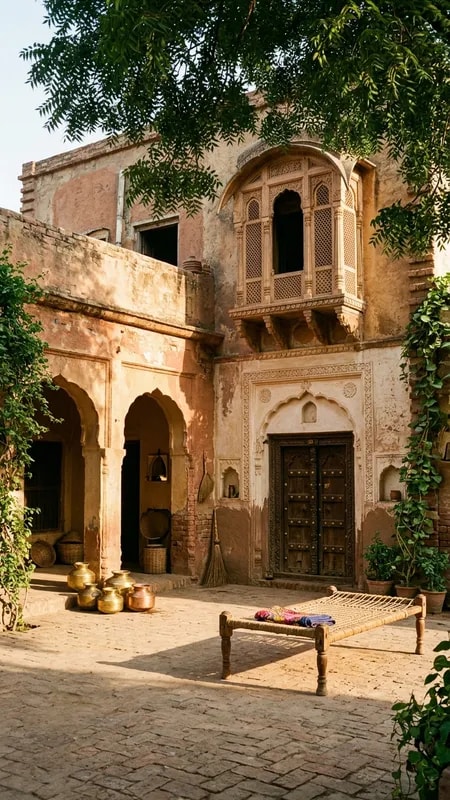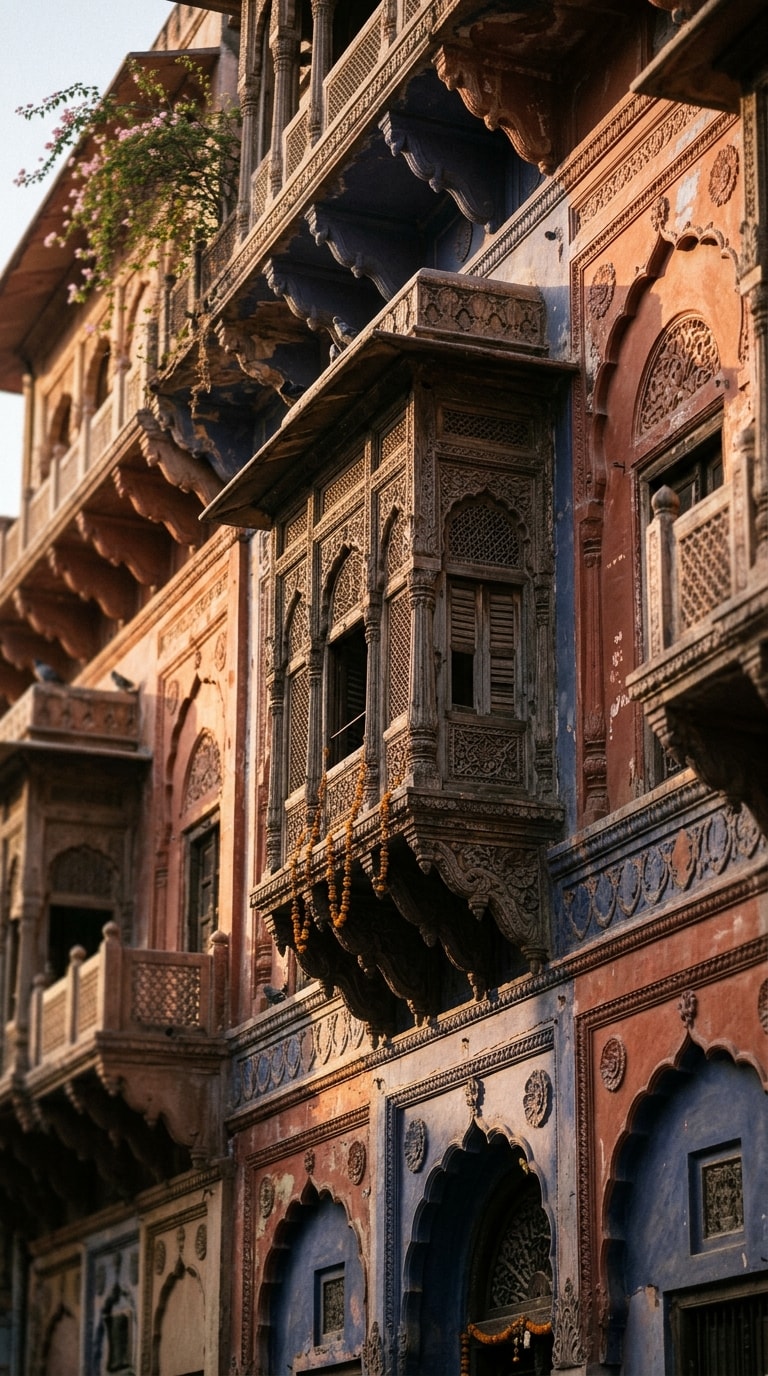
Stand close to a Rajwada facade and the first thing you notice is not a single carving but the argument between warm and cool. Sun-baked terracotta and peach catch the last direct light and glow almost edible, while every recessed bracket, arch reveal, and lattice opening drops into a deep indigo that reads closer to blue than brown. That contrast is the whole trick. It is not a colour scheme applied with paint; it is a colour scheme produced by geometry, and it changes hour by hour as the sun swings around the wall.
The jharokha at the centre of this composition works because it is both object and shadow-maker. Projecting from the wall on a heavy carved bracket, it throws a hard-edged silhouette across the plaster beside it and turns the scalloped arch below into a pool of cool darkness. Multiply that one element into a stack of them and you get the layered, honeycombed depth that defines the style. If you are borrowing the idea for a modern home, resist the urge to flatten it into a single decorative panel. Depth is the point: give the balcony real projection, let the bracket cast a real shadow, and keep the wall behind it plain so the shadow has somewhere to land.
The framing here is instructive too. A tight crop that runs past the top and bottom of the frame makes the house feel taller than any wide shot could, and a longer lens compresses the layers until the carving, the lattice, and the flowering creeper behind them sit almost on the same plane. In your own photographs, step back and zoom rather than walking closer. The wall becomes a tapestry instead of a diagram, and the ornament reads as texture rather than inventory.
Palette follows the same logic. Keep the masonry in the peach-to-rust range and let the blues arrive on their own, through shadow, through a painted door, through a length of indigo textile, or through the cool green of a trailing plant allowed to spill over a cornice. Three materials carry the whole look: lime plaster with a matte, slightly uneven surface; seasoned sheesham or teak left unlacquered so it darkens; and stone that keeps a rough tooled finish instead of a polished shine. Gloss kills the effect, because gloss reflects light evenly and flattens the very shadows you spent money to create.
What stays with you, finally, is the romance of it — the sense that the building was finished slowly, by hands that enjoyed the work. That feeling is not nostalgia for its own sake. It is what happens when structure and ornament are the same gesture, and when a house is designed to look its best in the twenty minutes before sunset.