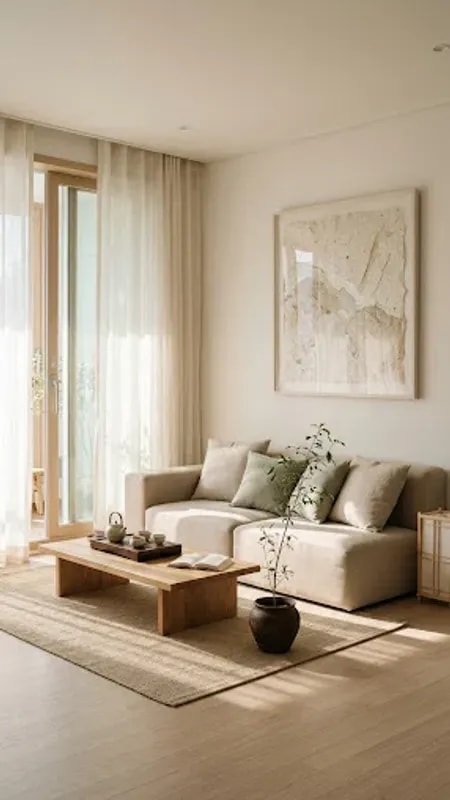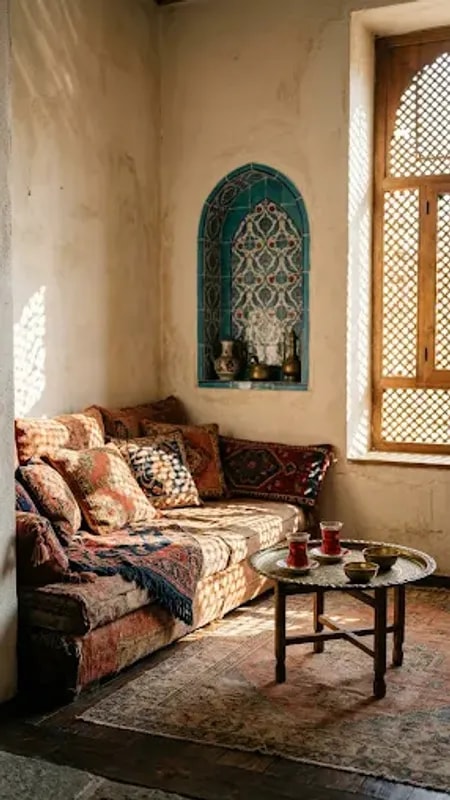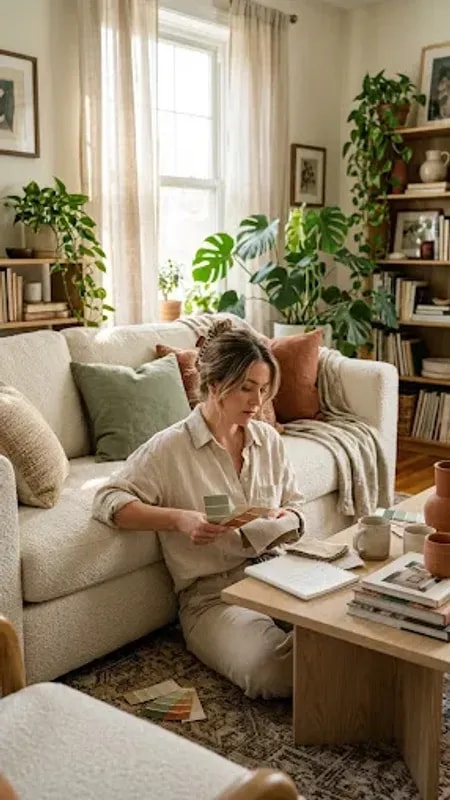
There is a simple way to judge whether a living room is truly finished: walk in with a notebook and see if you want to stay. Rooms built only for looking good tend to fail that test. They offer a sofa and nothing else — no surface at arm's reach, no light angled where a page needs it, no reason to linger past the first photograph. The room in this image passes because it was styled around the person standing in it, not around the camera.
The credenza is doing the heavy lifting. A long, low mid-century piece in warm wood gives the room its horizontal anchor and doubles as a landing zone for the things real life produces: stacked books, a couple of vases, a trailing plant that softens the hard top edge. Because the piece sits low, the wall above stays open, which keeps the ceiling feeling taller than it is. If you are copying this, resist the urge to fill every inch. Three objects grouped on one end, a plant on the other, and a stretch of empty wood in the middle reads as confidence rather than absence.
Colour follows the same logic. The palette is narrow on purpose: dark teal on the upholstery, mustard on the armchair, brass at the lamp, and wood tones running underneath all of it. That is four notes, and they repeat. The teal appears again in the rug's geometric pattern, the mustard echoes the warm grain of the credenza, and the brass ties the lamp to the small metallic details on the shelving. Repetition is what makes a limited palette feel rich instead of thin. Pick three colours you love, add wood as a neutral, and let each one show up at least twice.
The light deserves its own paragraph. Daylight arrives from the right and rakes across the room at a low angle, which is why the armchair glows and the plant casts a soft shadow on the wall behind it. That direction of light is worth protecting. Keep the window side of the room relatively clear, choose sheer or no window treatments, and place your brass floor lamp opposite so evening light comes from the other direction. A room that changes character between afternoon and night feels twice as large.
Finally, notice the rug. A geometric pattern underfoot does what plain flooring cannot: it defines the conversation zone, adds the visual rhythm the plain walls lack, and hides the small evidence of daily use. Ground the seating on it, leave a border of floor visible, and the whole arrangement reads as intentional. Add the notebook, and the room is done.