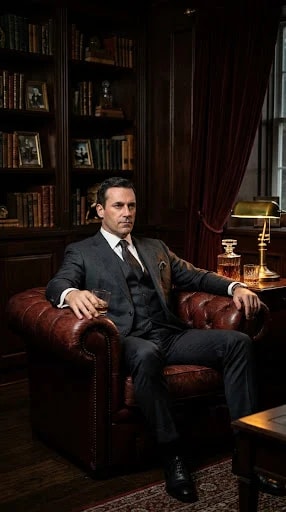
The most powerful element in a room is often the one that isn't there. In this image, the high-backed leather chair sits empty, yet it commands the entire space. It is positioned with intentional authority behind the heavy mahogany desk, a throne awaiting its ruler. This calculated vacancy isn't an oversight; it's a design statement. The chair becomes a symbol of impending judgment or clandestine meeting, its emptiness amplifying the sense of control held by the room's unseen occupant. The viewer is left to project their own narrative onto that space, a psychological game built into the very furniture.
Everything in the composition conspires to elevate this empty seat. The low camera angle forces us to look up at it, a visual metaphor for submission. The warm, dramatic pool of light from the brass desk lamp doesn't illuminate the room; it spotlights the chair's domain. The rich, dark palette of mahogany and burgundy absorbs light, creating shadows that feel like secrets held in the corners. Even the crystal decanter, catching a glint of amber, sits as a prop for a conversation that has yet to happen.
The mood is one of suspended action, a stage set between acts of power. This aesthetic taps into a deep cinematic language, evoking scenes of tense negotiation or solitary contemplation of empire. It creates a space designed not for comfort, but for influence. The opulence of the materials—the thick leather, the polished wood, the heavy crystal—serves as a tangible display of wealth, while the composition whispers of the intangible weight of command.
For a viewer, the effect is a complex cocktail of attraction and apprehension. We are drawn to the luxurious textures and the promise of a story, but we also feel the unease of an intruder in a private sanctum. This is the core of mafia style: it welcomes you with one hand while the other rests on a lever of consequence. The room doesn't just house power; its design actively performs it, with the empty chair as its lead actor.