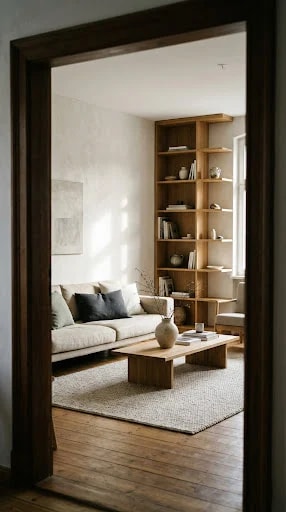
There is a particular pleasure in standing in a German hallway and looking through an open door. The room beyond arrives already composed: a beige sofa squared to the light, a pale oak table holding one rounded vase and a short stack of books, a shelf where ceramics sit with the confidence of objects that have earned their place. Nothing has been staged for the moment you walk in. It simply holds, the way a good photograph holds, and you are the one who has to move.
That view is not an accident. German interiors tend to be arranged around sightlines rather than around furniture sets. The doorway becomes a frame, the hallway becomes the viewing position, and the darker wood of the door casing does the work a gallery wall would do elsewhere — it narrows the picture and gives the eye somewhere to rest before it travels inward. Walk through and the composition dissolves into a room you can use. Stand back and it reassembles. This double life is the quiet trick of the whole approach.
The palette is doing just as much. Creams and warm greys, light oak, a single dark brown note, one black cushion that keeps the beige from floating away. German design has always been suspicious of the decorative flourish, but this is not coldness; it is a preference for contrast over color, texture over pattern. A textured wool rug underfoot, a linen slipcover with a visible weave, the matte surface of unglazed ceramic — these carry the warmth that a brighter palette would otherwise supply. The result feels calm without feeling empty, tidy without feeling unlived in.
The shelf is the tell. Open shelving exposes a household's discipline, and in a German living room it is usually treated as architecture rather than storage: books grouped by height, ceramics spaced with air between them, one shelf deliberately left sparse. It reads as order, but the more accurate word is care. Someone decided what deserves to be seen and what belongs behind a door. That editing instinct is what makes the room photograph so well and live so easily.
If you want to borrow the effect at home, start at the threshold rather than at the sofa. Stand in your hallway, look through the door, and ask what the room offers from there — one strong horizontal, one vertical, one thing worth looking at. Move the table until the light from the window grazes it. Take one object away. The German style is not a shopping list; it is the habit of composing a room for the moment before you enter it, so that arriving feels less like walking in and more like being let in.