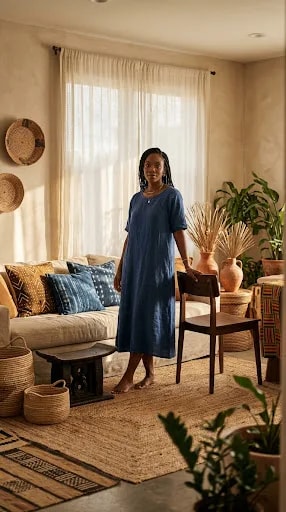
African style home design rarely announces itself with a single dramatic gesture. It works the way the room in this photograph works: a woven basket wall here, a carved stool there, a jute rug underfoot and a stack of terracotta pots holding dried grasses. Each piece is modest on its own, but together they build a room that feels grounded, warm and completely at ease with itself. The lesson is that texture, repeated patiently, does more for a space than any one statement object.
Start with the materials and let the palette follow. Earth tones carry this style naturally — cream, sand, tan, clay and deep brown — because they come straight from the source materials themselves. Wooden chairs and stools, jute and sisal rugs, hand-thrown pottery, cotton and linen upholstery: these finishes age well and grow softer with use. Against that neutral base, two or three saturated accents do the heavy lifting. Here it's indigo and mustard on the sofa pillows, echoed by the long blue dress and the deep green of the plants. Pick your accents from things you already love, then repeat them at least twice so they read as intentional rather than accidental.
Wall baskets are the quiet hero of this look. Grouped in an overlapping cluster above a sofa or beside a doorway, woven trays add pattern, shadow and rhythm without framing, glass or a nail-heavy installation. They're also forgiving: buy them one at a time at markets or while travelling, and the arrangement gets better as it grows. Mix diameters and weave densities, keep the gaps small, and let the edges of the group stay a little uneven. The same principle applies to a gallery wall, except baskets bring warmth and depth that flat art rarely matches.
Live plants and natural light finish the composition. Sheer curtains diffuse daylight into a soft golden wash that flatters clay, wood and woven fiber, while a few leafy plants — a monstera near the window, something trailing from a shelf — bring the green accent indoors and keep the room from feeling like a showroom. Budget for one or two generous plants rather than many small ones; scale is what makes greenery read as part of the architecture.
What holds all of this together is restraint in shape and generosity in feel. Keep furniture low and simple, let the handmade pieces be visibly handmade, and leave a little empty space so the eye can rest. The result isn't a museum of souvenirs. It's a room that looks collected over years, invites bare feet, and feels genuinely good to come home to.