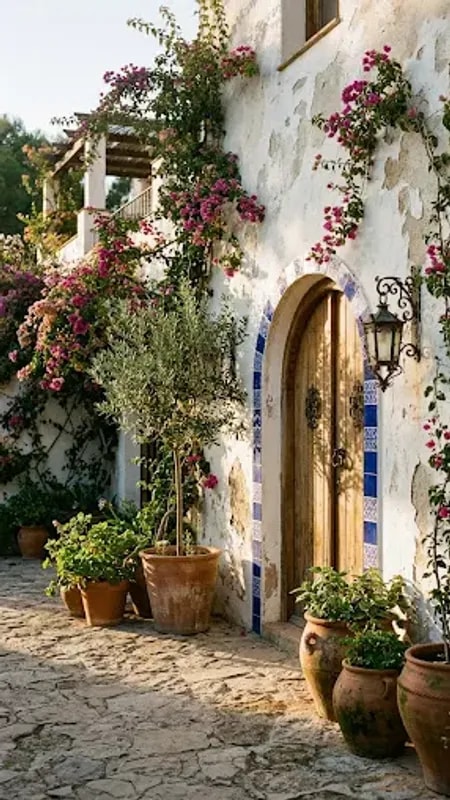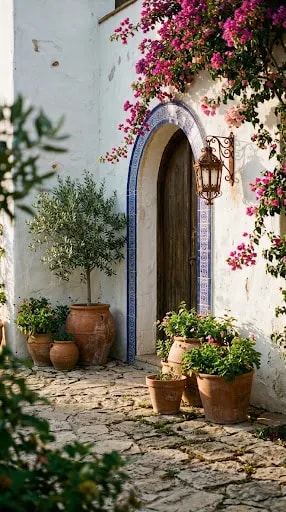
The most persuasive Mediterranean houses rarely announce themselves with a grand facade. They work through a single, concentrated gesture: a door set into a thick white wall, framed so carefully that you slow down before you reach it. Look closely at a good one and you will find the same few ingredients arranged with real discipline — an arch, a band of pattern, a lantern, and something green spilling over the edge.
Start with the opening itself. A true arch, even a shallow one, softens the whole wall above it and throws a curve of shadow that changes hour by hour. Rustic timber in a warm honey or weathered walnut finish keeps the shape from feeling formal; boards with visible grain and hand-forged iron studs or strap hinges read as carpentry rather than millwork. The white stucco around it should be thick and slightly uneven, troweled rather than sprayed, so the sun catches small variations instead of sliding off a flat plane. That texture is what makes the blue and pink in the rest of the scene feel so vivid by contrast.
The tile border is the detail people remember. A narrow run of blue and white patterned ceramic around the arch — Portuguese, Moroccan, or a simple hand-painted geometric — acts like a drawn line, telling the eye exactly where the architecture begins and ends. Keep the band slim, no more than two or three tiles wide, and let it stop where the wall turns a corner. Above or beside the door, a vintage wrought-iron lantern in a dark matte finish adds a vertical note and a hint of age; wire it to a warm bulb so it glows rather than glares after dusk.
Then comes the planting, which does most of the emotional work. Terracotta pots in staggered sizes, some chipped and sun-bleached, sit along the cobblestone path at the foot of the door — a small olive tree for structure, low green foliage for softness, and bougainvillea trained up and over so that magenta flowers hang into the frame. Leave the pots unglazed and let the terracotta stain; that patina is the point. If your foreground has a shrub or a leafy branch, let it blur into the edge of the view. Framing a doorway through foliage makes a courtyard feel deeper and more private than it actually is.
What ties it together is restraint. One arch, one tile pattern, one metal finish, one flower color repeated. The white wall does the rest, holding the light and giving every saturated note somewhere quiet to land.