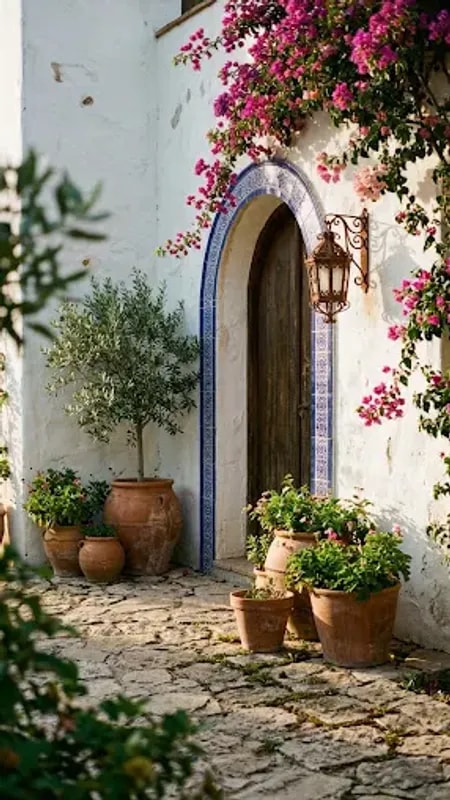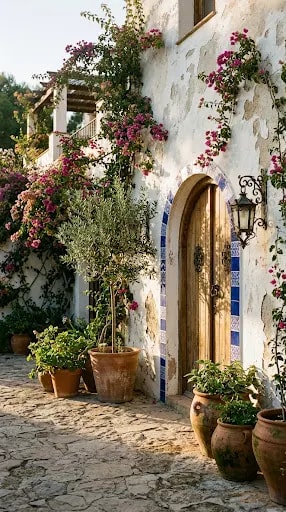
Mediterranean homes rarely announce themselves with a grand facade. They work in small, warm gestures: a chalky white wall that has softened under decades of sun, a plank door set deep into the plaster, and a band of blue-and-white tile that turns a simple opening into something ceremonial. The threshold does the greeting. Standing in a rough stone courtyard, with terracotta pots crowding the base of the wall and a wrought-iron lantern hanging overhead, you already feel received — before anyone has opened the door.
What makes the look convincing is texture rather than theme. Hand-troweled lime plaster, deliberately uneven, is the real star of the wall; the shadows that rake across it at low sun do work no paint finish can imitate. Let the stucco breathe and let it weather. Small hairline cracks, a chalky bloom near the ground, a slightly darker patch where the pergola drips — these are patina, not defects. Pair that softness with something hard and honest underfoot: irregular stone paving laid with wide, sandy joints, or old terra-cotta tiles worn smooth at the threshold. Mediterranean design is cumulative, assembled over seasons, which is why a courtyard that looks effortless usually took years of small additions.
Plants do the decorating, and they are allowed to be unruly. Bougainvillea thrown across a pergola is the classic move, its magenta bracts burning against white plaster; a potted olive brings the silver-green and a windblown silhouette. Where the wall is protected, let a vine climb. Keep the containers clustered and mismatched — unglazed terracotta in three or four sizes, some a little chipped, a few planted with rosemary or geraniums. Set them where the eye travels along the path to the door rather than in a tidy line, and raise the largest on a stone plinth so the planting reads at two heights.
Color should be spent in one place. That tight frame of cobalt and white tile around the door is enough; repeat the blue nowhere else except, perhaps, a shutter or a glazed pot, so the eye keeps returning to the entrance. The rest of the palette announces itself: chalk white, terracotta, olive, sun-bleached wood on a small balcony above. Keep ironwork dark and simple — a lantern on a bracket, a slender handrail — and let the flowers supply the drama.
The lesson from a courtyard like this is scale and restraint. One strong doorway, one good wall, one climbing plant, and a handful of pots will read as a Mediterranean villa far more persuasively than a full renovation of matching fixtures. The sun does the rest.