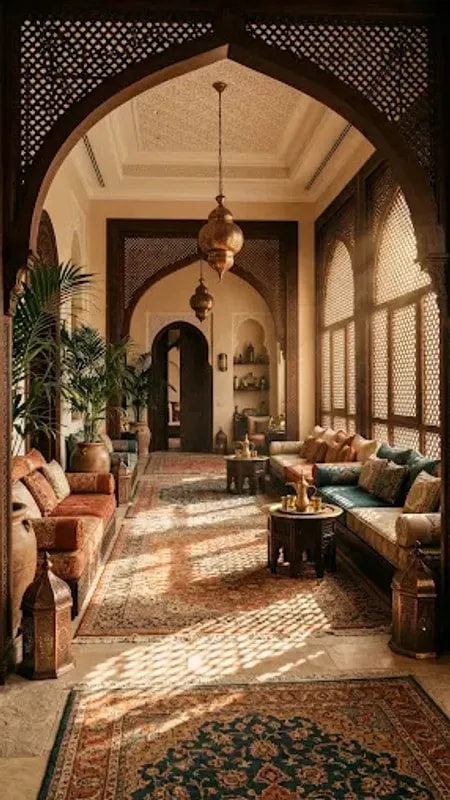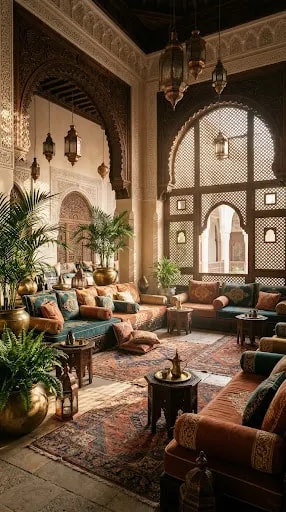
Step into a well-made Arabic-style living room and the first thing you notice is not a piece of furniture but a structure: an arch, repeated and layered, pulling the eye from the sofa in front of you toward a lattice window at the far end. That depth is deliberate. Traditional design treats the room as a sequence of frames rather than a single open box, so each carved opening reveals a little more — a brass planter catching sun, a palm frond, the glow of a hanging lantern — and the space feels larger and calmer than its footprint suggests.
The mashrabiya screen is the quiet hero of the composition. Turning a wall into a pierced wooden lattice does two jobs at once: it filters the harsh afternoon light into a soft, dappled wash and it protects privacy without sealing the room off. In the image, that screen reads as a warm grid of light and shadow falling across a patterned rug, and it is the reason the palette of terracotta, rust, teal, and antique gold feels glowing rather than heavy. If you are adapting the look at home, treat the screen as a light fixture as much as a wall.
Low seating is the other structural decision. Cushioned benches wrap the perimeter of the room, following the line of the arches instead of standing free in the middle. This keeps sightlines open, makes the ceiling feel taller, and turns the floor itself into the social space — a rug becomes the stage, and small inlaid tables are placed within reach rather than in the center. Layering textiles in teal and rust against cream upholstery gives the eye something to rest on without breaking the calm.
Ornament here is concentrated rather than scattered. Carved wooden arches, a pierced screen, metal lanterns, and a few brass vessels carry the detail, while the plaster walls and pale ceiling stay quiet. Greenery does the rest: potted palms and ferns soften the hard edges of wood and stone and add the one color that makes terracotta sing. Notice how few objects there are and how carefully each sits — a cluster of lanterns, a pair of planters, a single low table — each one given room to be seen.
The lesson for anyone borrowing this style is restraint with a strong frame. Commit to the arch, commit to the screen, let one warm light source do the work of many, and leave space between things. The luxury in an Arabic majlis is not quantity; it is the sense that the room was built slowly, for shade, for tea, and for company that stays a while.