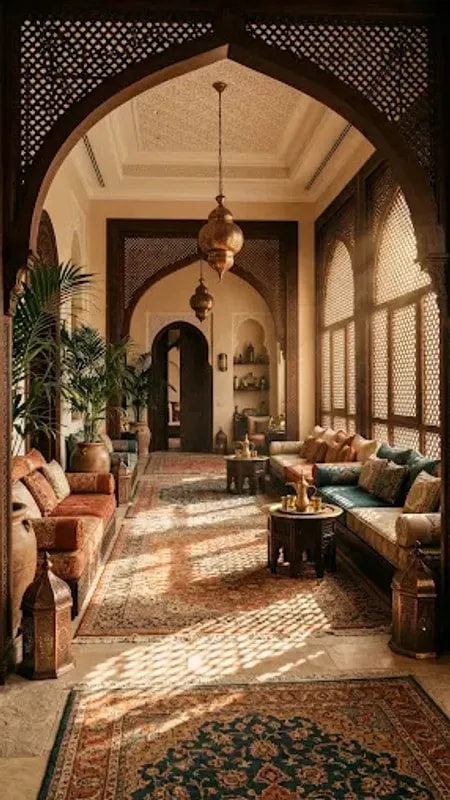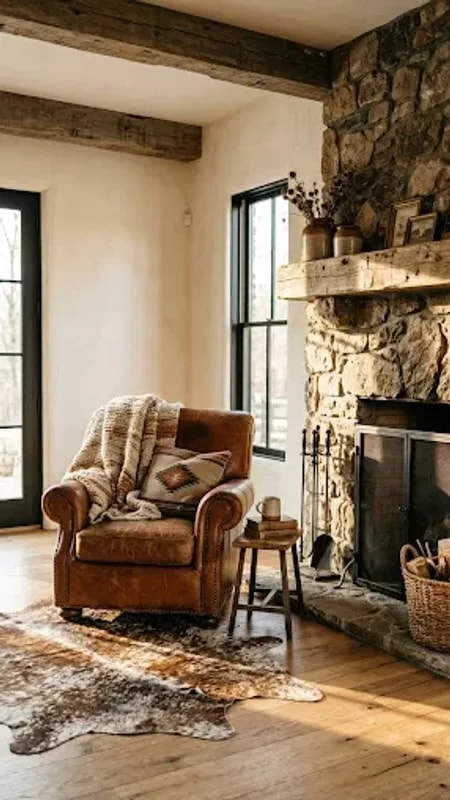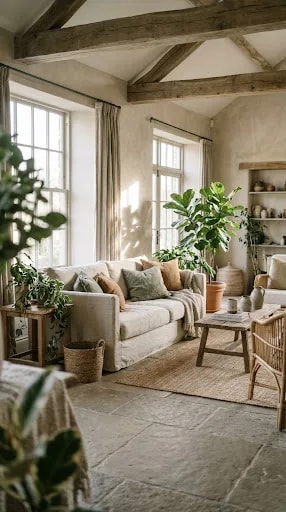
The sun does most of the decorating here. Late in the afternoon it stacks through tall multi-pane windows, filters past unbleached linen curtains, and lands in soft rectangles across a jute rug and flagstone floor. Everything in the room — the creamy plaster walls, the weathered ceiling beams, the slipcovered sofa piled with sage and rust cushions — seems chosen less for how it looks under a spotlight than for how it behaves in ordinary daylight. That is the quiet discipline of natural style home design: build a room that improves as the light moves through it.
Start with honest surfaces. Natural style home design falls apart the moment gloss enters the picture, so keep walls in lime plaster or a chalky matte paint, floors in stone or wide-plank wood, and timber visible enough to show grain, knots, and a few decades of wear. The exposed beams overhead do more work than any accessory; they give the eye something structural to rest on and make the height of the room feel earned rather than empty. Choose finishes that will look better, not worse, after five years of sunlight and footsteps.
Then restrain the palette. Sand, cream, greige, muted green, terracotta, and the brown of old wood will carry an entire room if you let three or four of them lead. Keep saturation low and let the plants supply the vivid green — a fiddle-leaf fig near the window does more for the scheme than another cushion would. Textiles should look gathered rather than styled: a throw draped over the arm, a linen curtain pooling slightly, cushions in oatmeal and sage that have gone a little soft. Nothing crisp, nothing matching.
Layer the floor and the edges. A woven jute rug over stone warms the room without hiding it, and baskets, ceramics, and a rattan chair tucked into the corner add the texture that flat walls can't. Open shelving holding everyday pottery reads as lived-in rather than displayed, and a low wooden table with books and a couple of hand-thrown cups invites the room to be used. Leave space between things; the calm in this room comes as much from what's absent as from what's there.
If you're starting in your own home, don't overhaul everything at once. Paint one wall in a chalky cream, lay down a natural fiber rug, move your largest plant toward the brightest window, and bring in one piece of worn wood. Then wait a season and see how the light changes the room before you add anything else.