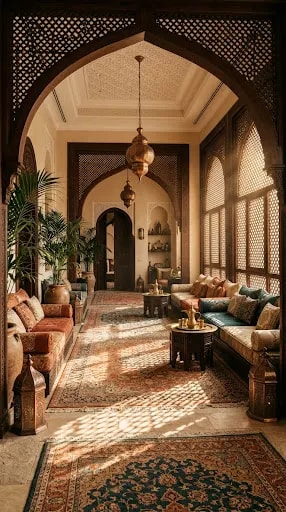
Stand in the doorway and the house performs a small trick on you. A dark wooden arch frames the view, and beyond it the hallway does not simply continue — it unfolds, one keyhole arch after another, each slightly smaller than the last, until a far doorway glows with daylight. The effect is theatrical but not fussy. Nothing in the corridor shouts; the architecture does the talking, and the eye travels the full length of the house in a single glance. In Arabic home design, circulation space is rarely treated as leftover square footage to be hurried through. It is the spine of the plan, and it is finished accordingly.
The repetition is the engine of the whole composition. Each arch is carved with the same vocabulary of geometric relief, yet the spacing tightens as the corridor recedes, and that gentle compression is what produces the sense of grandeur in a passage that is, in truth, not especially wide. Anyone borrowing the idea for a narrower Western hallway can take the principle without the full mosque-scale program: pick one profile — pointed, keyhole, or a simple flattened ogee — and repeat it two or three times down the run with consistent trim depth. Consistency reads as calm. Variation in width, not in style, is what creates the pull toward the light at the end.
Light is the second material here, and it enters from the side. A tall mashrabiya screen on the right filters the afternoon into a lattice of bright diamonds and soft shadow that slides across the floor and up the plaster as the sun moves. That moving pattern is worth designing around rather than fighting: keep the walls near the screen plain, let the floor be pale enough to hold the projection, and place the brass lanterns where their glow will read at dusk once the lattice fades. Dark timber in the foreground does the rest, giving the bright distance something to push against.
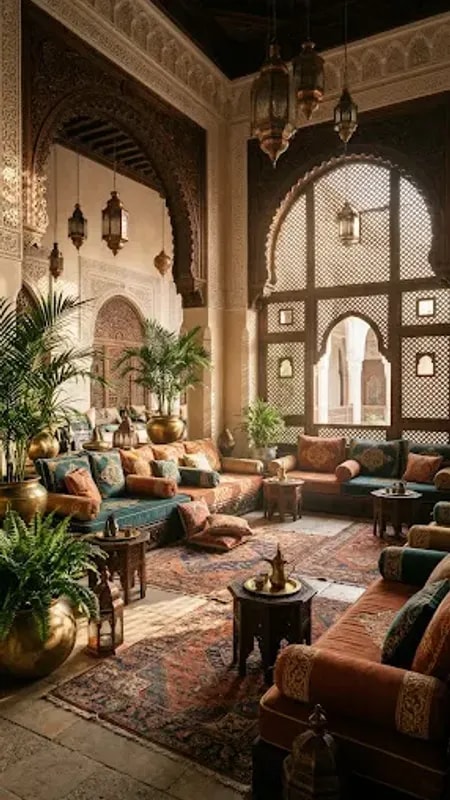
Furnishing stays low and to the edges so the arches keep their lines. A rust-colored bench and a deep teal seating group sit against opposite walls, close enough to feel conversational but clear of the sightline; a long patterned runner repeats the geometry overhead without competing with it; palms in glazed pots soften the corners. Carved side tables hold a tray, a lamp, a book — nothing more. The restraint is deliberate. In a corridor like this, every object is seen in silhouette against daylight, so only the good ones earn a place.
The lesson travels well. One arch where a plain opening used to be, a screen that throws pattern rather than blocking the view, a rug running the length of the hall, and a warm light left burning at the far end will give almost any house that same invitation to keep walking.