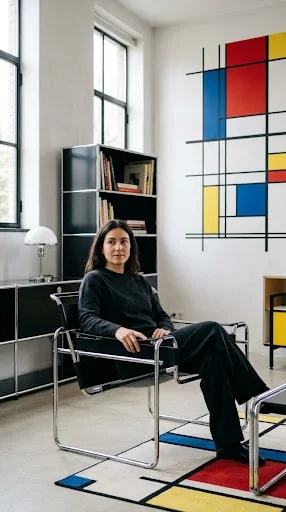
A woman settles into a tubular chrome lounge chair, black leather slung between polished steel, and the room arranges itself around her. Behind her, a black grid shelving unit holds books at regular intervals. A low black cabinet carries a single white dome lamp. Tall industrial windows pour in flat, even daylight that lands gently on a floor rug mapped out in red, blue, yellow, black, and white. Nothing in the frame is decorative for its own sake, yet the whole scene feels warm enough to stay in all afternoon. That tension between discipline and comfort is the real lesson of Bauhaus style home design.
The movement's rules are simple enough to borrow without a design degree. Form follows function, so every object should earn its footprint. Materials stay honest: chrome reads as chrome, wood as wood, leather as leather, with no faux finish pretending otherwise. Color arrives in primaries, used as punctuation rather than wallpaper. Here the yellow drawer on a small wood side table does more work than a whole accent wall would, because the surrounding palette of black, white, and metal gives it something to argue against. The grid does the rest, appearing in shelving, window mullions, and the Mondrian-style mural that turns a flat wall into an organizing principle.
What keeps this from feeling like a showroom is restraint plus a little softness. The black grid unit is filled, not styled within an inch of its life. The lounge chair is genuinely comfortable, which was always the point: Bauhaus designers cared about the body in the chair, not just the silhouette. Natural light from those tall windows does most of the atmospheric work, so the lighting plan stays quiet. If you want the look without the chill, keep the geometry strict and relax everything else. Add a wool throw, a couple of worn paperbacks, a plant that refuses to sit at a right angle.
Starting your own version is mostly about editing. Choose one iconic piece, a cantilever chair or a tubular frame table, and let it anchor the room. Hold the palette to black, white, chrome, and two primaries at most. Repeat a single grid motif three times, in shelving, window treatment, and art, so the eye finds rhythm instead of clutter. Then leave space empty on purpose, because negative space is the material the movement uses most generously.
Bauhaus style home design works best when it remembers it was built for people who read, rest, and put their feet up. The lines stay honest, the geometry stays legible, and the room stays liveable. That balance is not decoration. It is a daily practice.