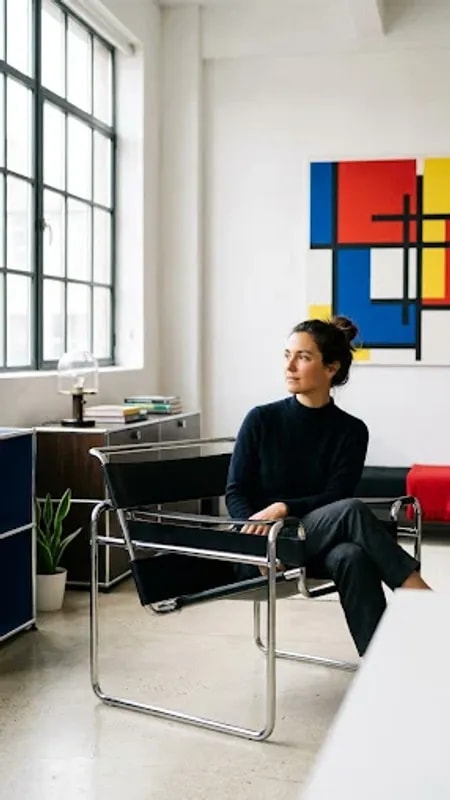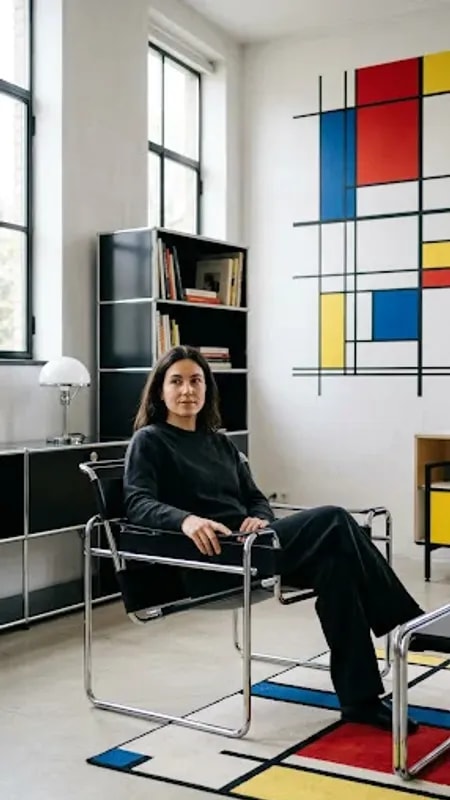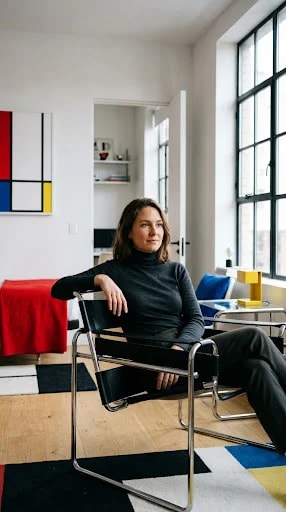
A Bauhaus room can look like a diagram if you let it. The trick, visible in almost every good example, is that the geometry stays in the architecture and the furniture while the color arrives in small, deliberate doses. Look at a well-resolved version of the style and you find white walls, pale wood underfoot, a black-framed industrial window, and then, almost as punctuation, a red tablecloth, a Mondrian canvas, a rug with a handful of primary blocks. The grid is there. It just never shouts.
Start with a single chair and treat it as the room's anchor. A chrome tubular frame with black leather upholstery does more work than three accent pieces combined: it is the piece you sit in, the piece that catches the daylight from the window, and the piece that explains the whole philosophy without a caption. Keep the silhouette clean and the frame thin. Place it slightly off-axis rather than squared to the wall, so the room reads as lived in rather than staged. A person seated in that chair, low and centered against strong vertical lines, is the best proof of concept a design movement ever had.
The window deserves equal weight. Bauhaus interiors are often brightest at the edge of the frame, not the center, and that is the point: light enters from one side, falls across pale floorboards, and lets the shadows do the decorating. Resist heavy curtains. A black metal frame with slim glazing, left mostly bare, gives you the industrial note and the daily theatre of moving light at once.
Color needs a budget. Pick three moments of red, blue, and yellow and stop. A canvas on one wall, a cloth on a small table, a rug whose blocks echo the artwork. Repeat each hue once elsewhere in the room, seen through a doorway, so the eye travels. Everything between those moments should be white, black, chrome, or wood, which is what keeps the palette playful instead of chaotic.
Finally, leave the sightlines open. A doorway that reveals shelves, a second chair, a lamp in a warm accent color gives depth without clutter. Bauhaus style at home is not about owning less for its own sake; it is about letting each object justify its place, then stepping back so the daylight and the geometry can be seen.