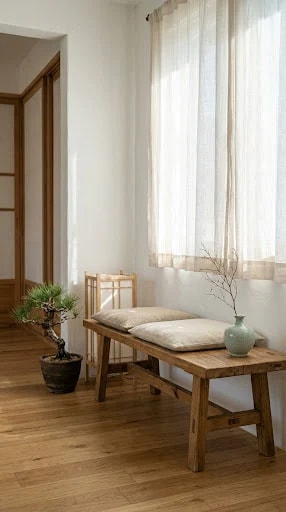
Most homes treat the entry as a corridor with a mat in it. Korean design treats it as a room that happens to have a door. The difference is small in square footage and enormous in feeling: instead of a place you walk through, you get a place that walks you down. In this entryway, everything conspires to lower the pace. The floorboards run warm and continuous toward a slatted door in the distance, and the eye follows them the way a hand follows a railing.
The anchor is a solid wood bench, rustic enough to show its grain and low enough that sitting on it feels like a small decision rather than a collapse. Two flat linen cushions in beige soften it without dressing it up. Nothing here invites you to perch and scroll; the bench is a shelf for a bag, a coat, a body removing shoes. That single piece of furniture sets the height of the whole room, and everything else answers to it. A slim wooden floor lamp stands at its shoulder, its shade low enough to light the floor instead of the ceiling.
The asymmetry is deliberate and worth stealing. On one side, sheer white curtains filter the morning into something closer to mist, catching a celadon vase and its few bare branches in silhouette. On the other, a meticulously pruned pine sits in a pot beside the lamp, its dark needles holding the corner down. One side dissolves, the other side grounds. If you mirror the same objects on both sides of your own entry, you get a showroom; if you let light lean one way and weight lean the other, you get a moment.
Green is doing more work here than decoration. The pine is the only saturated thing in a palette of oak, cream and grey-white, and because it is the only one, it reads as a decision rather than a theme. A plant in an entryway also solves a practical problem: it gives you something to look at while you fumble for keys, which keeps the space from feeling like a checkpoint.
To recreate the effect, start with the floor and the light and let the objects come last. Keep the palette to three tones, choose one piece of furniture low enough to sit on comfortably in shoes, and place the lamp so it grazes the boards rather than the wall. Then leave a little emptiness near the door — a few feet where nothing is asking for your attention. That gap is the whole idea. It is the space that lets you arrive before you enter.