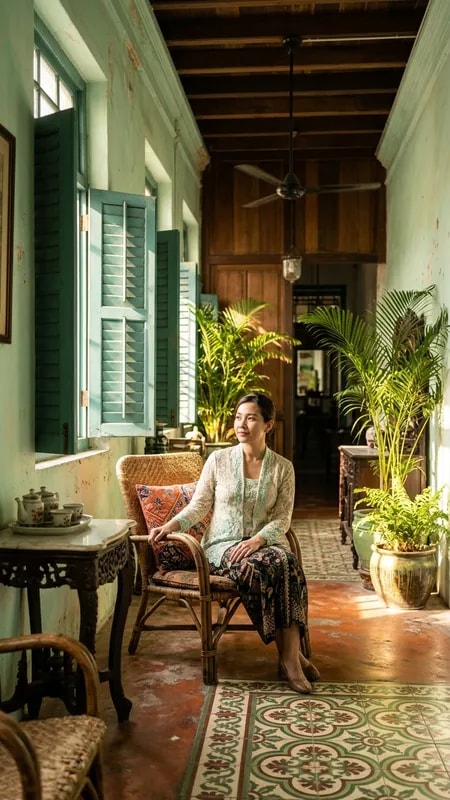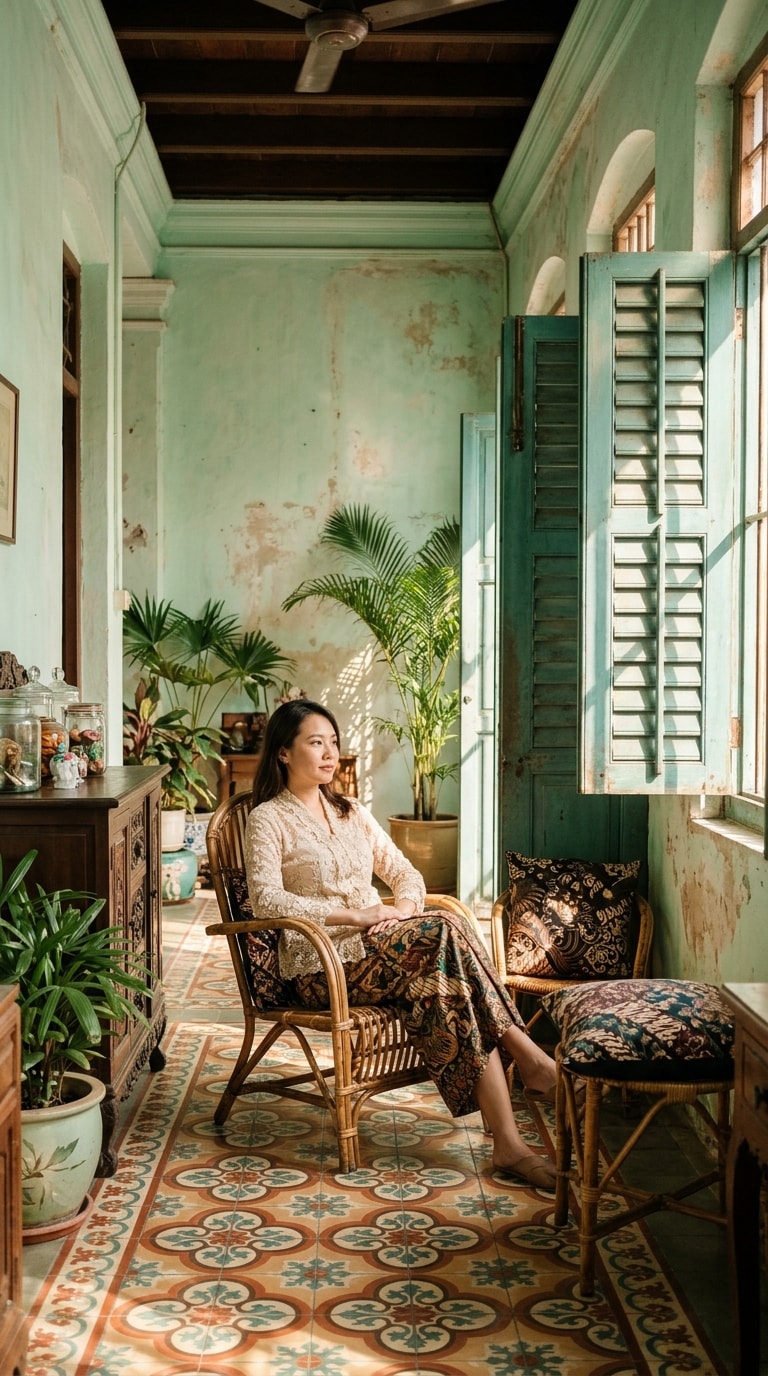
At the end of a shaded corridor, a rattan armchair holds a quiet afternoon. The seat is worn smooth at the arms, a cushion has been pushed into the small of the back, and light arriving through tall louvered shutters falls in stripes across the floor. This is the moment that explains Nanyang style better than any showroom could: not a room arranged for company, but a corner arranged for rest. Mint-green shutters, half closed against the hottest hours, do the quiet work of filtering the sun into something you can sit inside.
Nanyang style comes from the region the name points to — the Nanyang, or "south seas," as Chinese emigrants called Southeast Asia. What grew there was a genuine hybrid: Chinese shophouse proportions, Malay timber craft, Peranakan ornament, and colonial-era ventilation resolved into houses built for heat, rain, and extended family. The style is less a palette than a set of decisions about climate. Deep verandahs, air gaps above interior walls, raised thresholds, tile floors that stay cool underfoot — every decorative choice in a Nanyang home began as a practical answer to the tropics.
The details in this corridor carry that history in miniature. The floor is a field of encaustic cement tiles patterned in terracotta, ochre, and muted green, laid decades ago and softened by footsteps, never meant to match perfectly. Against the wall, a dark timber cabinet with glass doors holds the good china and whatever else a family could not bear to part with. A patterned stool sits where it was last used. Palms in glazed pots lean toward the light, adding the one thing tile and timber cannot: something alive. None of it is staged, and that is exactly why it works.
To bring the feeling home, start with light rather than furniture. Louvered shutters, timber slatted blinds, or a deep eave that cuts the glare will do more for a room than any purchase. Then choose one heritage moment and let the rest stay quiet: a single tiled threshold, a strip of patterned cement underfoot, a cabinet with glass doors. Add rattan or cane seating that breathes in humidity, a wooden stool, a few palms. Keep the edges soft and the surfaces imperfect, because Nanyang style loses its soul the moment it looks new.
What the image really records is a pace. Shutters closed at noon, tea going cold, a chair that has held the same body for years. A Nanyang home is not designed to impress a visitor at the door; it is designed to make the afternoon pass slowly and comfortably. Build one corner that asks nothing of you, and the rest of the house will start to follow.