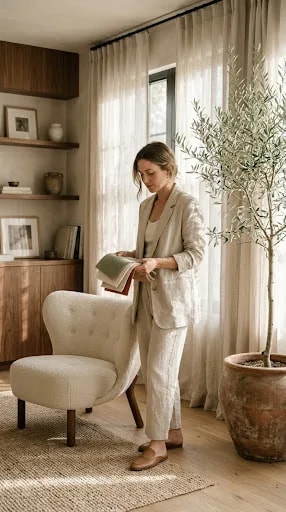
Some corners of a house are built for passing through, and one or two are built for staying. The difference is rarely expensive. It comes down to a chair placed at the right angle to the window, a light that never turns harsh, and a surface within arm's reach for the book you are halfway through. In this room, a woman in a beige linen suit stands beside a cream upholstered chair, reading. Nothing about the scene is staged for drama. It is staged for duration, which is a harder thing to get right.
Start with the chair, because everything else arranges itself around it. Choose something with a low, generous arm and a back you can sink into rather than perch on, then pull it slightly away from the wall so it reads as furniture for a person, not filler for a gap. Position it perpendicular to the window rather than facing it directly. Cross light is kinder than glare, and it lets the curtains fall behind your shoulder the way sheer floor-length panels do here, softening the daylight before it ever reaches the page. A woven jute rug over pale wood anchors the whole grouping without closing it in.
Behind the chair, warm wood built-in shelving does quiet structural work. The trick to shelves that feel lived-in rather than merchandised is mixing heights and materials on each bay: a short stack of horizontal books, a tall vase, a small framed artwork propped rather than hung, a few objects with visible wear. Leave one open stretch of shelf per bay. That negative space is what keeps a wall of cabinetry from turning into a wall of clutter, and it gives the eye somewhere to rest between objects.
Then add something alive. A tall olive tree in a weathered terracotta pot brings the vertical line the corner needs, and its silver-green leaves look right against creams, oatmeals, and honeyed wood in a way that glossier houseplants do not. Olive likes the same bright, filtered light the chair does, so the pairing tends to hold up. Keep the pot slightly matte and imperfect. A little dust on terracotta is part of the palette.
Finally, protect the calm. Keep the floor around the chair clear, hang art at seated eye level rather than standing height, and resist the urge to fill every surface. A reading corner works when it looks like it has been used gently for years and left alone since. Give it soft light, one good seat, and a shelf that invites browsing, and you will find yourself arriving with a book and no particular plan to leave.