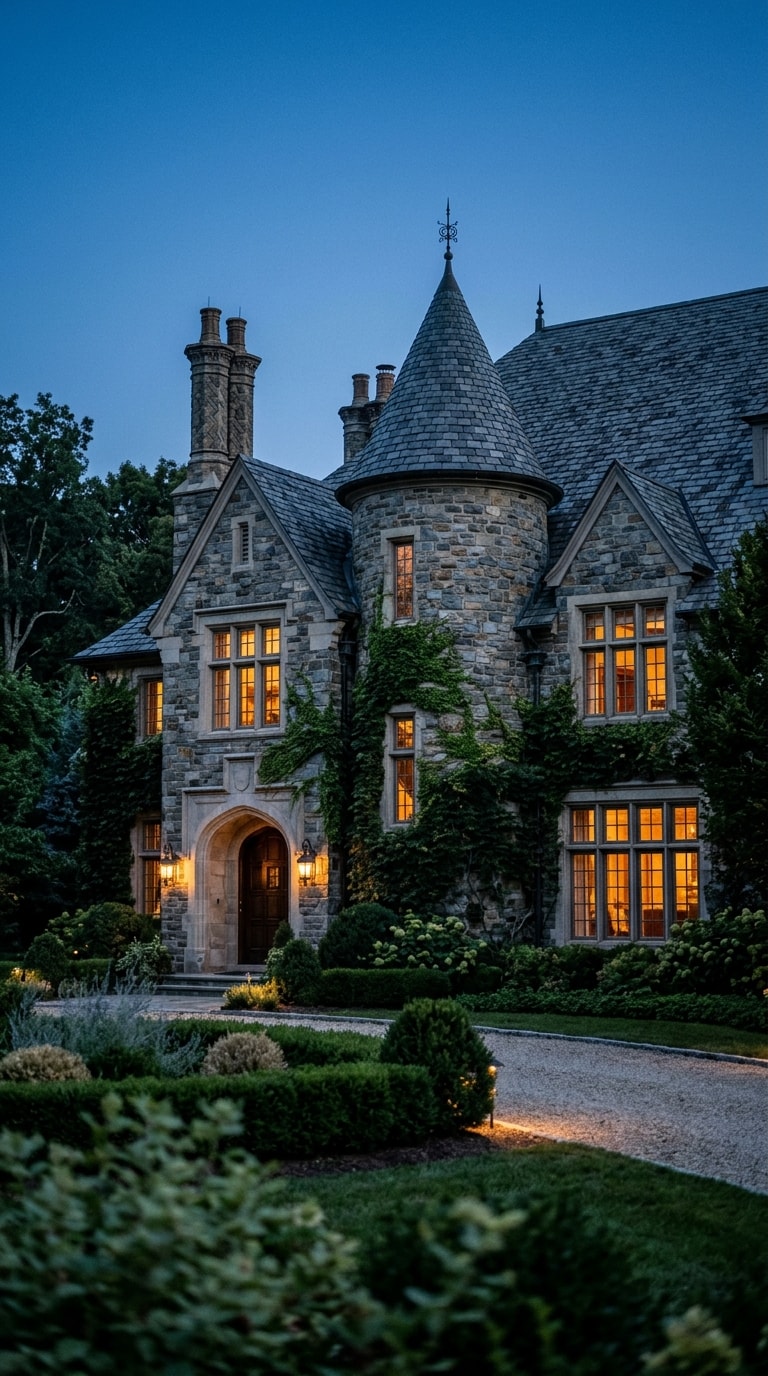
There is a particular hour, just after sunset, when a stone house stops being architecture and becomes a mood. The photograph captures exactly that moment: a deep cerulean sky overhead, slate roofs going dark, and every mullioned window glowing amber from within. A conical turret rises at the corner, chimneys stand at attention along the roofline, and ivy softens the edges of the masonry. The gravel drive curves in, hedges hold their shape, and the whole composition tilts upward, as if the house is still growing. That upward pull is the first lesson of castle style home design: it is a vertical style, and it works best when the eye is invited to climb.
Structurally, the vocabulary is old and specific. Steep pitches shed weather and create dramatic silhouettes. Round towers and turrets break a long facade into something memorable. Tall, narrow chimneys add rhythm against the sky, and a single arched entry gives the front door the weight of an occasion. Rough-cut stone in cool grays keeps the palette grounded, while the profile does the theatrical work. The trick is restraint. One turret reads as character; four read as a theme park. Choose an anchor, let the rest of the house stay calm, and the fantasy holds.
Landscaping does as much heavy lifting as the stone. Here, clipped hedges create a formal apron around the base, keeping the planting low so the building's height stays visible. Ivy climbing the entry arch adds age without hiding the craftsmanship of the doorway. Gravel rather than asphalt keeps the arrival soft and quiet underfoot. If you are translating this look to a smaller property, borrow those three moves, geometric hedging, a gravel or stone path, and a framed entry, and you will get most of the effect for a fraction of the budget.
The lighting is the quiet hero. Warm sconces and interior glow against cool blue dusk is a classic complementary pairing, and it works because the contrast is deliberate rather than decorative. Replicate it by layering: uplights washing stone texture, low-wattage fixtures at the door, and interior lamps on dimmers so windows read as lived-in rather than lit up. Avoid cool-white bulbs outside, which flatten stone into gray concrete. Amber light on gray stone is what makes the house feel inhabited and, frankly, enchanted.
What makes castle style endure is not the turret itself but the sense that the house was built slowly, by hands that cared about corners. You can chase that feeling with a single arched window, a stone chimney, or a slate-colored roof. The fairy tale is in the details, and the warmth behind the glass does the rest.