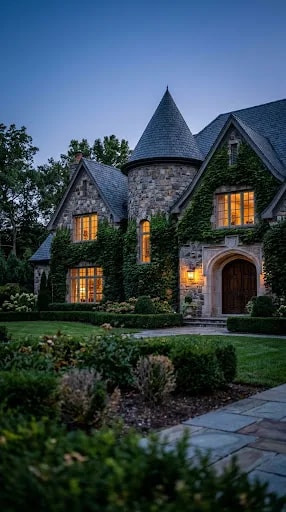
Every castle-style home has a moment where the fantasy has to meet a person. In this twilight view, that moment is the arched wooden door set into the base of the round turret, with a single warm sconce burning beside it. The tower, the slate cone, the ivy gripping the stone — all of it is theatre. But the door is the handshake, and the design succeeds because the handshake is warm.
Start with proportion at the entrance, not at the roofline. A turret this size invites an oversized door, and the arched top keeps it from reading as a slab. The arch should echo the curve of the tower above it, so the eye travels from the round slate cap down through the stonework and lands on a matching curve at head height. Material matters as much as shape: a heavy timber door with visible grain and dark iron hardware signals age and craft, and the surrounding stone should be laid with a slightly rougher face near the opening so the dressed jambs look deliberate rather than accidental.
Then treat light as architecture. The magic in a blue-hour photograph like this one comes from the collision of cool sky and amber spill, and that same collision can be built on purpose. One well-placed exterior sconce, shielded so it grazes the stone instead of blasting it, does more for a facade than a dozen evenly spaced downlights. Inside, mullioned windows should read as glowing panels rather than dark holes, which means warm bulbs in the 2400 to 2700 kelvin range and generous window proportions. A recessed entry also helps: depth gives the sconce something to model, and it gives a visitor a place to stand out of the weather.
The approach deserves the same care as the facade. Here, a pale stone pathway runs straight to the door, doing the quiet work of pulling a visitor forward, while clipped hedges flank it and stop the planting from spilling into the walk. Let the borders stay a little loose — soft blooms and unfussy groundcover keep the stonework from feeling severe. Ivy climbing a turret is romantic; ivy swallowing a door frame is a maintenance problem, so keep a clean margin around the arch and hardware.
Castle style is often mistaken for a test of how much stone you can stack. The better test is what happens in the last three feet before the door: whether the scale steps down, the light softens, and a person standing there feels less like an intruder and more like a guest expected at exactly this hour.