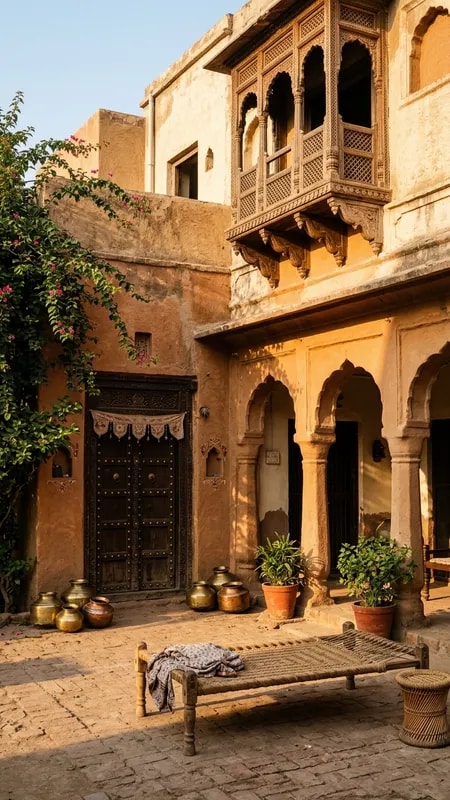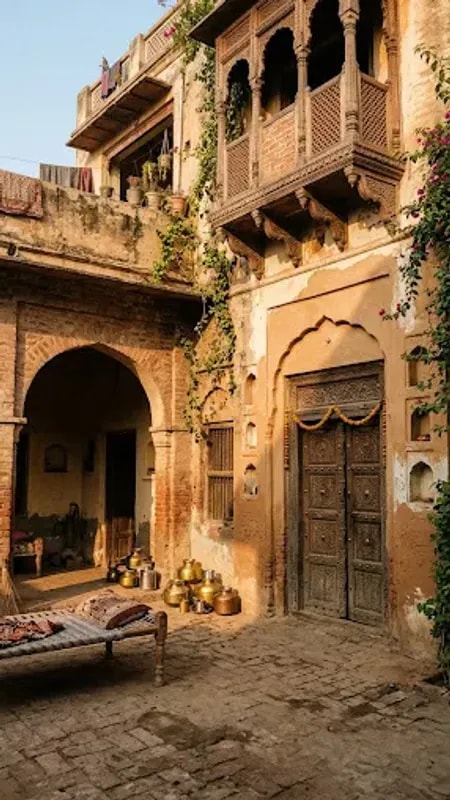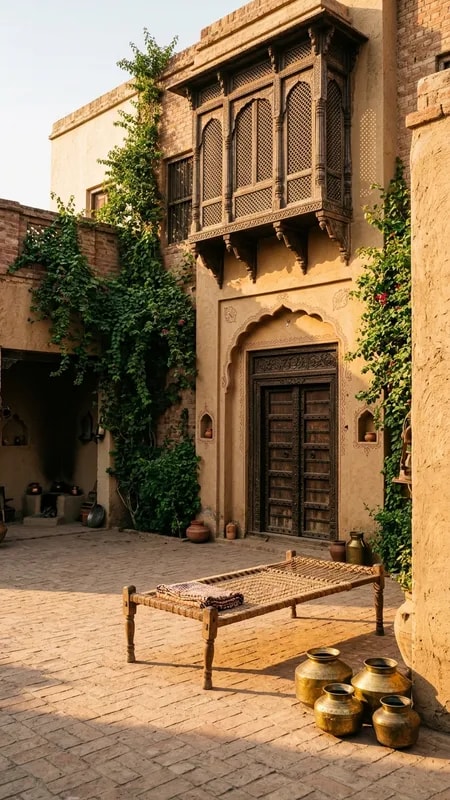
The photograph captures the kind of detail that stops you mid-step: an enclosed balcony, or jharokha, carved from warm terracotta stone and set against a wall of indigo blue. Its lattice screen is a geometry lesson in patience, each opening framed by a slender column and topped with a scalloped arch. Heavy brackets support the overhang, casting deep shadows in the golden-hour light. Decorative stone railings run below, and the whole composition feels less like a facade than a piece of jewelry pinned to the building. This is Rajwada style at its most concentrated—ornament with a purpose, crafted to be seen from below and admired from within.
Rajwada architecture grew out of the Maratha palaces of central India, where the jharokha served both ceremony and climate. From these projecting balconies, royal women could watch street processions without being seen; the stone lattice admitted breezes while blocking harsh sun. The style favors locally quarried stone, deep overhangs, and scalloped arches that soften the transition between indoors and out. Decoration is never random: brackets echo the shape of the arch, railings repeat the lattice rhythm, and color—terracotta, ochre, indigo—is applied in confident blocks rather than fussy patterns. The result is grandeur that feels structural, not applied.
To bring Rajwada style into a modern home, resist the urge to replicate an entire palace. Instead, treat the jharokha as a single, deliberate focal point. A carved balcony can crown a stairwell, frame a bedroom window, or divide a courtyard from a living room. Work with artisans who understand local stone—soapstone, sandstone, or even cast concrete that mimics the depth of carving. Keep the palette grounded: let terracotta and earthy browns dominate, then introduce indigo on a single wall or door. Lighting matters as much as material. Warm, directional light from the side will rake across the lattice and reveal the shadows that make the carving legible, just as in the photograph.
Practicality keeps the look honest. A stone jharokha needs structural support, so plan it into the build rather than bolting it on later. Lattice screens require cleaning and occasional repointing; choose a stone that weathers well in your climate. Pair the ornate balcony with quiet modern surfaces—microcement floors, plain plaster walls, slim brass fixtures—so the carving can breathe. The goal is not nostalgia for its own sake but a home that carries a sense of place. When a jharokha is done well, it gives even a new house the weight and warmth of something inherited.