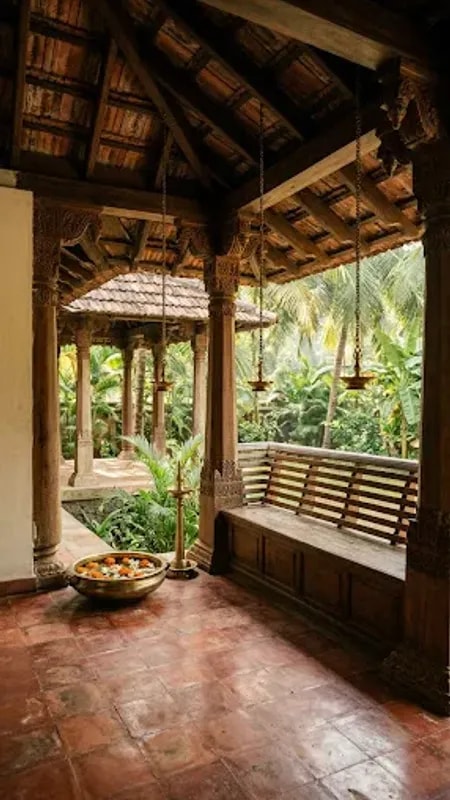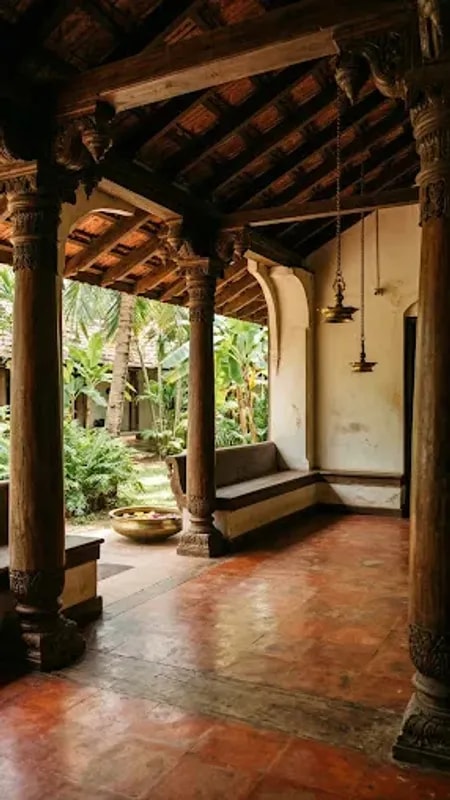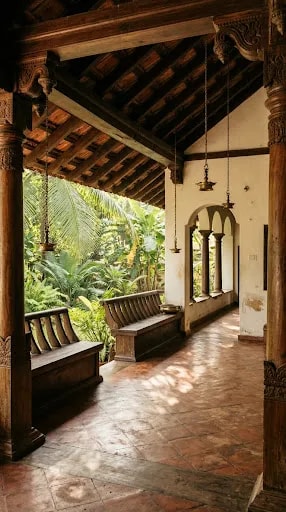
Most houses treat the corridor as a chore, a strip of floor to be crossed quickly. This one asks you to stop. The passage runs straight and narrow, paved edge to edge in weathered terracotta tiles the colour of weak tea, and its far end dissolves into green. Two slatted wooden benches sit against the open side, not facing each other but both facing out, like seats on a platform. Above them the roof drops low and dark, held by carved pillars whose surfaces have been softened by years of monsoon air. Nothing in the composition is precious, and that is precisely why it works.
The floor does most of the quiet labour here. Terracotta is porous, slightly uneven, and never fully one colour, so dappled sunlight arriving through the trees lands as a pattern of soft coins rather than a glare. Polished tile would have thrown that light back at you; this surface drinks it. If you are rebuilding or restoring, resist the urge to seal everything into uniformity. Let the tiles keep a little texture, lay them in a simple running bond, and allow the shade to vary from burnt orange to dusty rose. The floor will age in a way that makes the room feel older and calmer than it is.
The architecture along the edge is doing something specific: it refuses to close. Between the carved pillars there is no glazing, only a low parapet and a bench, so the boundary between inside and garden is a change of level and a change of sound rather than a wall. The steeply sloped timber roof overhangs far enough to keep the rain off the tiles, and the deep shade it creates makes the foliage beyond look almost luminous. A single arched window punctuates the creamy lime-washed wall opposite, its wooden mullions dividing the view into slender vertical panels. It is the only decoration on that wall, and it is enough.
Brass lamps hang in a loose line overhead, unlit in daylight, their weight giving the ceiling a rhythm it would otherwise lack. They are the kind of object that earns its place twice: as light after dusk, and as warm metal against dark timber before it. The benches deserve the same credit. Built in rather than bought, they occupy space that would otherwise be wasted and quietly invite the habit of sitting without a reason, which is the real luxury of the style.
To borrow the effect, keep one long sightline unbroken, spend your budget on the floor and the frame rather than on furniture, and let the planting press close enough to be heard. Then leave the corridor alone for a decade.