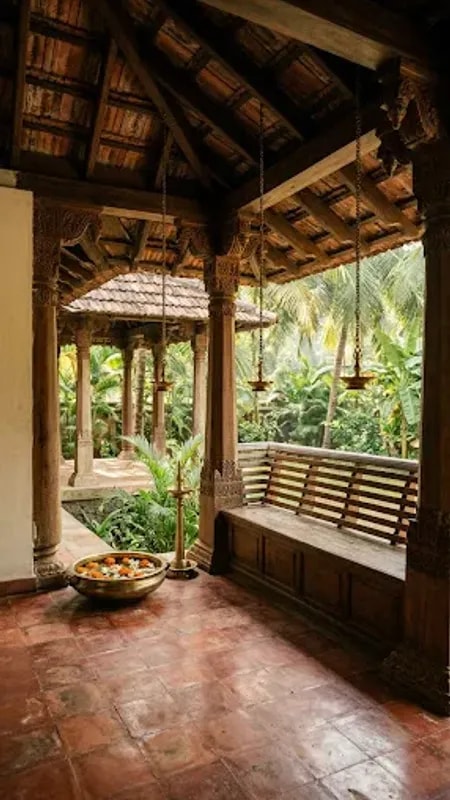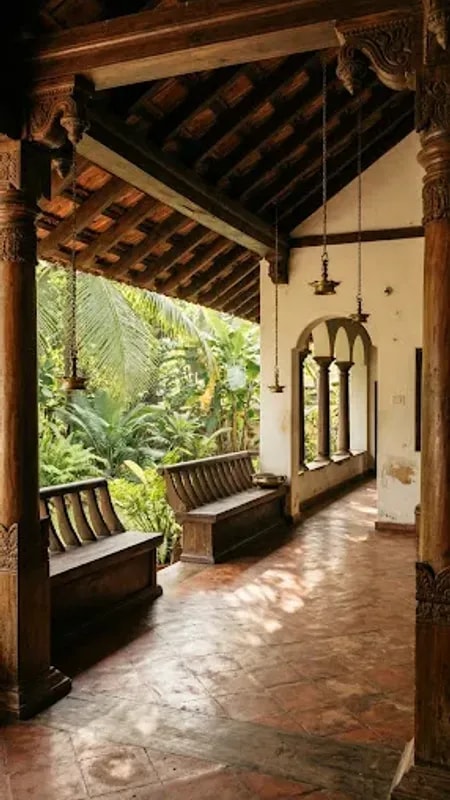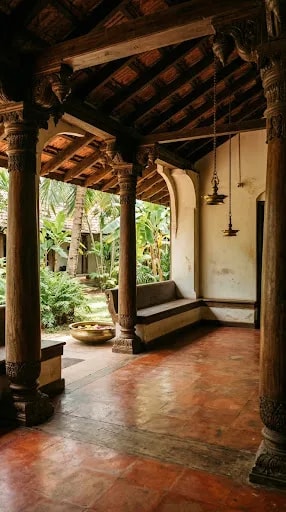
Most visitors look past the verandah on their way to the living room, but in a traditional Kerala home the verandah is already the living room. It is the first room of the interior, not a leftover strip of shade. The carved wooden pillars in this image do not merely hold up the roof; they set a rhythm, framing the courtyard and the banana leaves beyond like a row of dark, hand-cut columns in a gallery. The terracotta floor and the exposed rafters above run in parallel lines toward the doorway, pulling the eye inward while the body stays at the edge, half in the garden and half in the house.
Everything here earns its place. The built-in wooden bench against the cream wall is a seat, a ledge for drying feet, and a social boundary where neighbors pause without entering. The brass hanging lamp gives the shade a warm center of gravity even in daylight, and the brass bowl of water and flowers turns a daily chore into a small ceremony. The pale wall is not empty; it is a quiet surface that lets the carved wood, the red floor, and the green outside read clearly. This is Kerala style home interior design at its most honest: local materials, visible joinery, and decoration that can be used.
The section through the roof explains the comfort. A sloped roof with exposed rafters throws deep shade, while soft light from the left skims the pillars and tiles rather than flooding the space. The verandah works as a climate buffer, keeping the sun off the inner walls and letting cross breezes pass through before they reach the rooms. In the monsoon it becomes a dry outdoor room; in the heat it is the coolest seat in the house. The earthy palette of brown, terracotta, cream, and green is not a styling choice but the natural result of wood, fired clay, lime, and living plants.
Modern renovations often close this edge, replacing the open verandah with a sealed lobby and a security grille. The result is cooler-looking on paper and much poorer to live in. A better approach is to keep the threshold deep, repeat the verandah's materials inside—wood for furniture, brass for light, terracotta or a similar warm tile underfoot—and let the garden remain visible from the sofa. The verandah teaches restraint. It shows that a home can feel generous without being large, and that the most memorable room is sometimes the one between inside and out.