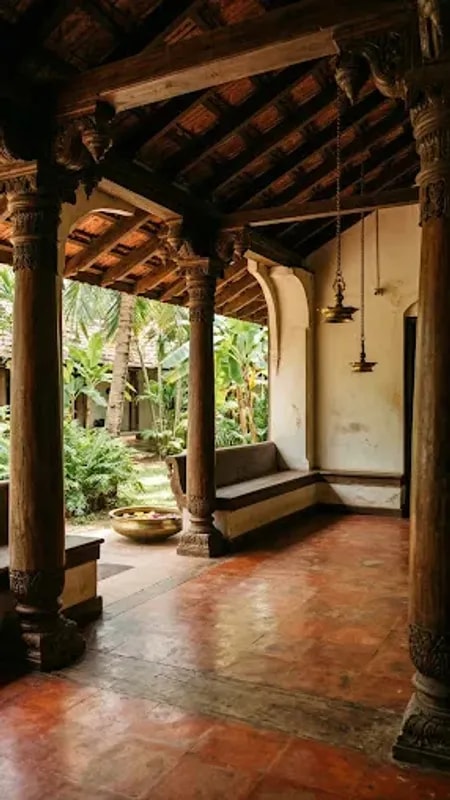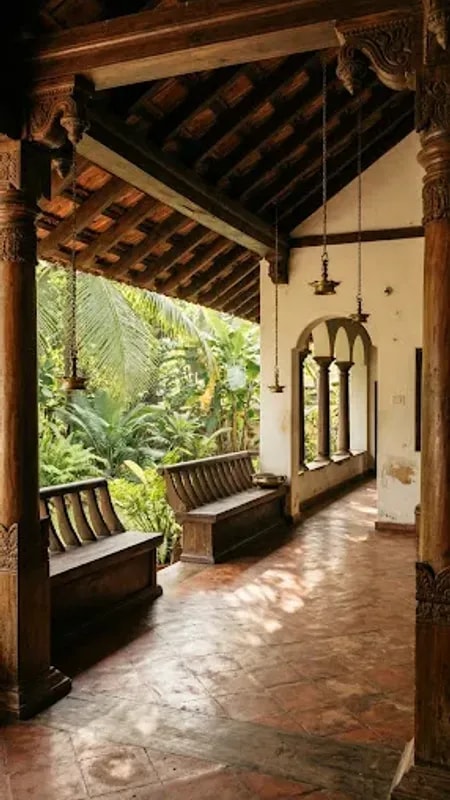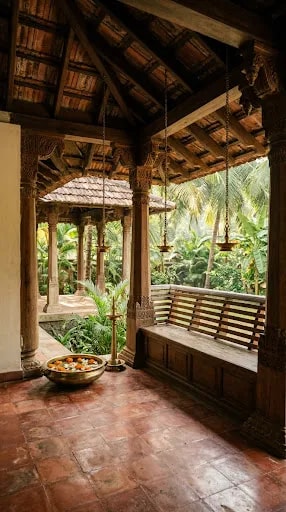
Most rooms tell you where to walk. This one tells you where to sit. The built-in timber bench — the charupadi you find along the verandahs of traditional Kerala houses — runs the length of the wall with its back to the house and its face to the courtyard, so that anyone who settles there is automatically looking outward. The proportions are generous but not deep; your feet reach the floor, your shoulders rest against warm wood, and the whole architecture quietly arranges itself behind you. Underfoot, the deep red oxide and terracotta tiles stay cool through the hottest part of the afternoon, which is why the floor is always the first thing bare feet find.
What makes the shade work is the frame. Instead of a wall, there is a grid of carved wooden pillars and a slatted timber roof that lets the garden show through in vertical strips. The slats cut hard sunlight into soft bands, drop the temperature a few degrees, and give the eye a rhythm to follow from the dark foreground out toward the green. The carving on the pillars earns its place here: it is decoration that also breaks up the view, so the courtyard beyond never reads as a flat green screen but as something layered, glimpsed, half-hidden. This is passive cooling dressed as ornament, and it is the reason the space feels cool even before you notice why.
Then there is the brass. A wide bowl of water with flowers floating in it, a couple of hanging lamps, and that is the entire inventory. It is a small lesson in restraint: one object, placed exactly where you pass it every morning, does more for a threshold than a shelf of collected things. The water catches the light from the courtyard and throws it upward onto the ceiling beams, and the flowers change with the season, so the room is never quite the same two weeks running.
To borrow the idea, start with the seat rather than the decoration. Build a bench along one wall, deep enough to lie on if you can, and orient it toward the best thing you own — a tree, a courtyard, a long view. Keep the floor hard and cool. Leave one side genuinely open, or as open as your climate allows; in cold regions this becomes a glazed sunroom and the mood shifts, which is fine, as long as the slatted light survives. Then add one brass or ceramic vessel and stop.
The luxury being offered is not ornament. It is a room that asks nothing of you except that you stay, with a bowl of water holding flowers and no particular place to be.