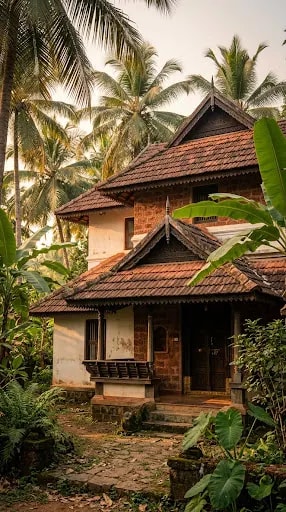
The first thing this elevation does is refuse to shout. Coconut palms lean across the frame, banana leaves spread wide in the foreground, and the house sits low between them as though it had been there longer than the garden. Nothing about the facade competes with the greenery. The roof pitches steeply and steps back, the porch recedes into shadow, and the whole composition reads less like architecture placed on a plot and more like a structure that was allowed to settle into one.
That roofline is doing most of the quiet work. Clay tiles in burnt orange are laid at a steep angle, far sharper than most suburban roofs, because in Kerala the sky does not negotiate. Deep eaves throw the walls beneath into shade for much of the day, keeping the plaster cool and the timber dry. Seen from the road at golden hour, the tiles catch the last light while the spaces below stay dim and inviting — a simple trick of shadow that makes even a modest home feel composed.
Below the roof, the elevation leans on contrast rather than ornament. Exposed brick, warm and slightly rough, meets panels of white lime plaster that carry the soft unevenness of hand work. Dark wooden pillars hold up the porch, their grain visible, their finish matte rather than glossy. There is no fussy carving here, no applied decoration. The detailing comes from the materials themselves: the weight of the posts, the texture of the brick, the way a lime finish takes light and gives it back slowly.
What makes the image linger, though, is how completely the landscape is folded into the design. Palms rise higher than the ridge, so the house never feels taller than its setting. Broad leaves overlap the lower walls, softening the corners where building meets ground. A well-planned elevation like this almost always begins by surveying what already grows on the site and building around it — keeping the mature coconut palm instead of clearing the plot, letting the garden edge creep close to the porch instead of stopping at a hard boundary of lawn.
For anyone planning a similar elevation, the lessons are practical. Choose a roof pitch that suits heavy rain and let the eaves run deep. Pair two or three honest materials — clay, timber, brick, lime — and stop there. Keep the porch low and shaded. And treat every existing tree as part of the facade, because in this tradition the house is never finished on its own; it is finished by the garden around it.