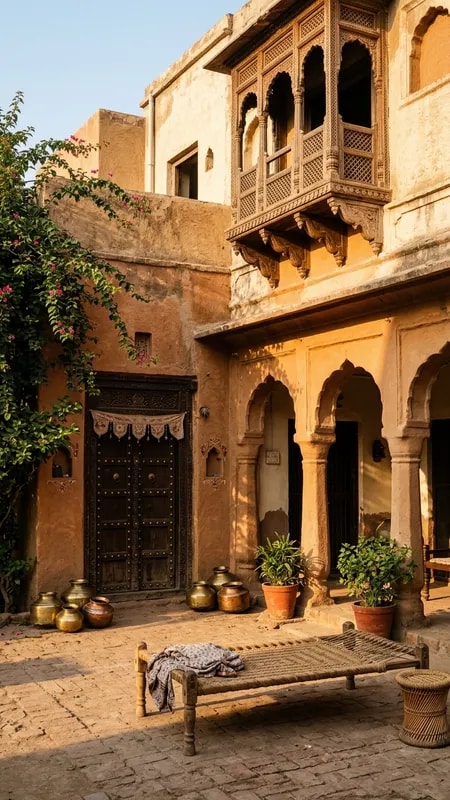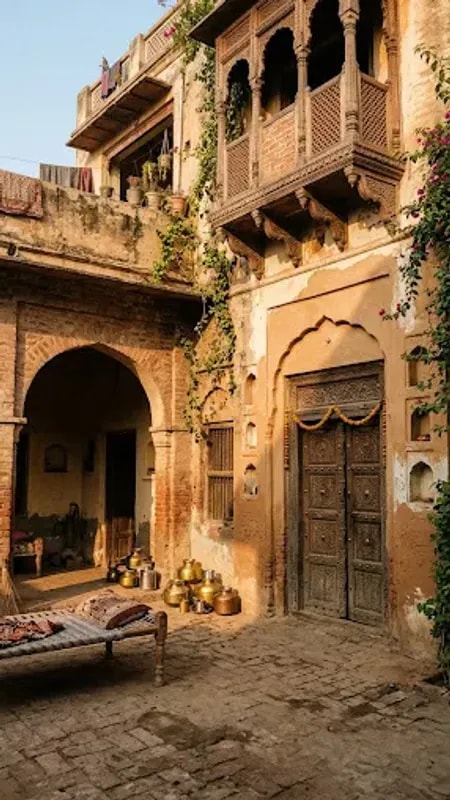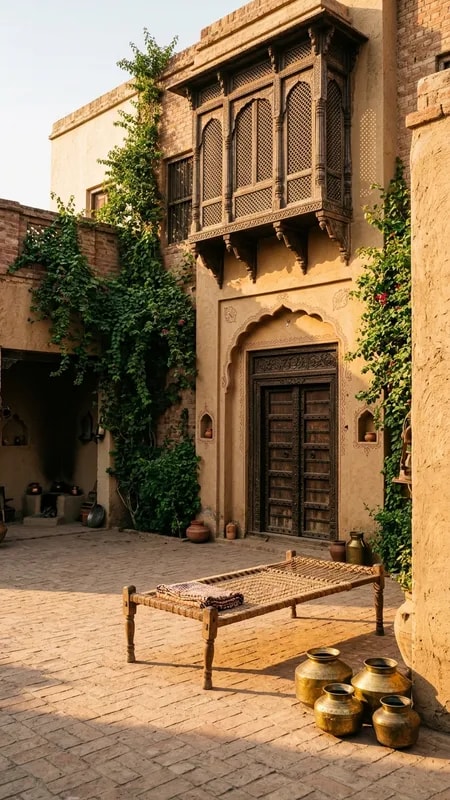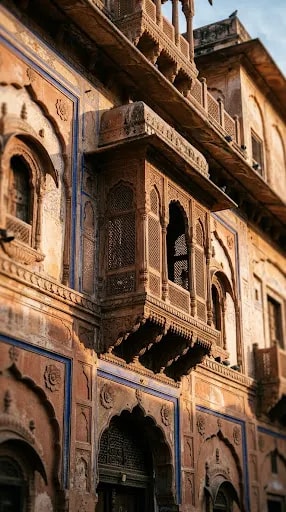
Most people photograph a Rajwada facade straight on, framing the whole elevation like a postcard. This view does something braver: it tilts upward into a narrow vertical slice, cropping away the building's edges until only the stacked layers remain. What emerges is a lesson in depth. The wooden jharokha pushes forward, the sandstone wall holds back, the carved brackets bridge the gap, and the indigo border traces the whole assembly like a signature. Nothing here sits on a single plane, and that is precisely why the wall feels alive.
Look closely at how the light behaves. Golden hour rakes in from the side, so every projection throws its own shadow — under the balcony slab, behind each lattice panel, along the underside of the brackets. Those shadows are not decoration; they are the architecture describing itself. A flat wall with painted ornament could never do this. If you are translating Rajwada style into a modern home, start with projection rather than pattern. A deep window reveal, a bay that steps out half a metre, a chajja overhang with real thickness, a recessed niche cut into a plain plaster wall — these give the sun something to work with across the whole day. Depth is the cheapest luxury available to any facade, and it costs nothing but a decision about how far things should stand proud.
The material contrast deserves just as much attention. Warm terracotta sandstone, deep brown timber, and that sudden ribbon of royal blue — three registers, each doing a different job. The stone carries mass and texture, the wood carries craft and fineness, and the blue carries the accent that stops the whole composition from settling into monochrome. In a contemporary setting, that logic survives translation easily: a rough lime-plaster wall, a teak or sheesham screen, and one saturated band of indigo on a door frame, a cornice edge, or a window shutter. Keep the accent narrow and repeated. Rajwada builders never spread colour thin across everything; they concentrated it.
There is also a vertical story being told here. The eye climbs through a multi-foil arch, past a latticed screen, up to a second balcony set slightly back. Each level steps inward, so height is measured rather than asserted. Homes with modest footprints can borrow this by staggering — a projecting window box above, a recessed balcony below, a parapet that steps rather than runs flat. The upward rhythm reads as grandeur even on a small plot.
Finally, notice the restraint of the tight crop: it forces attention onto craftsmanship. A single well-carved bracket, a lattice panel with genuine precision, one arch with a properly cut profile will carry more character than a facade scattered with half-hearted motifs. Choose your one gesture, give it real depth, light it well, and let the sandstone do the rest.