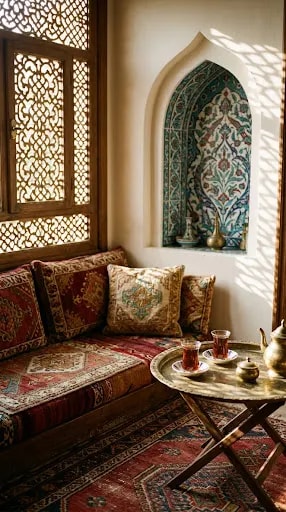
Nothing in a Turkish house is arranged by accident, and the smallest corner is often the most carefully composed. Here the whole room gathers around a low built-in seat, a sedir, wedged into the angle where two cream walls meet. Above it, a wooden lattice screen breaks the afternoon into a grid of bright lozenges that slide across the plaster as the sun shifts. The light does most of the decorating; the walls simply hold it. Sit down and the geometry lands on your shoulders and on the rug at the same moment, which is exactly the effect the room was built for.
The anchor of the arrangement is the tray. A round brass table, barely knee-high, sits at the precise distance where a hand can reach a glass without standing up. On it: tulip-shaped tea glasses, a small teapot, a dish of sugar. Proportions matter more than the pieces themselves. The table has to stay below the seat line so the eye travels over it rather than stopping at it, and anything taller than a teapot — a vase of branches, a lamp — breaks the low horizon that makes these corners feel so unhurried.
To one side, an arched niche is set into the wall and lined with Iznik tiles in emerald and cobalt, their tulips and carnations repeating in a slower rhythm than the lattice overhead. Small metal vessels, a ewer, a bowl, a lidded cup, rest on the shelf as both objects and color notes. A niche like this is not storage. It is a framed pause, a place where the eye rests between the cushions and the window, and it earns its keep by staying nearly empty.
Textiles do the rest. Crimson and gold cushions are stacked rather than scattered against the back of the sedir, and the rug beneath carries the same reds in a worn, vegetable-dyed pattern. The trick is repetition with variation: two or three jewel tones held against a cream ground, so the color reads as a single chord instead of a collection of fabrics. Add one more pattern and the corner tips into noise.
To build something similar at home, begin with the light. Place the seat where a screen, shutter, or pierced panel can throw pattern across a plain wall for at least part of the day, and resist filling that wall with anything else. Keep the palette to cream plus three saturated tones, give the display niche a single function, and hold the tea table low. What results is not a museum corner but a working one, where the kettle, the glasses, and the sun all arrive at the same hour.