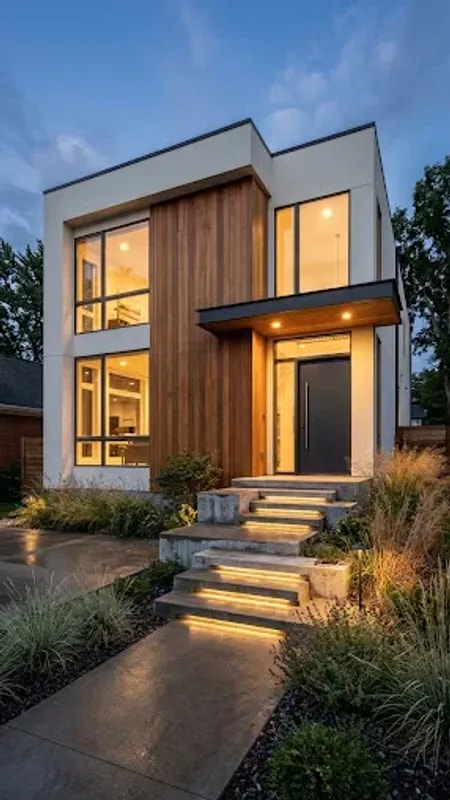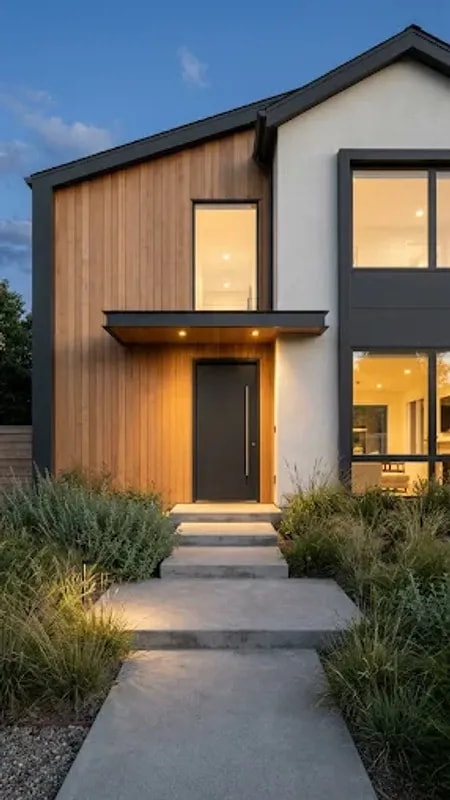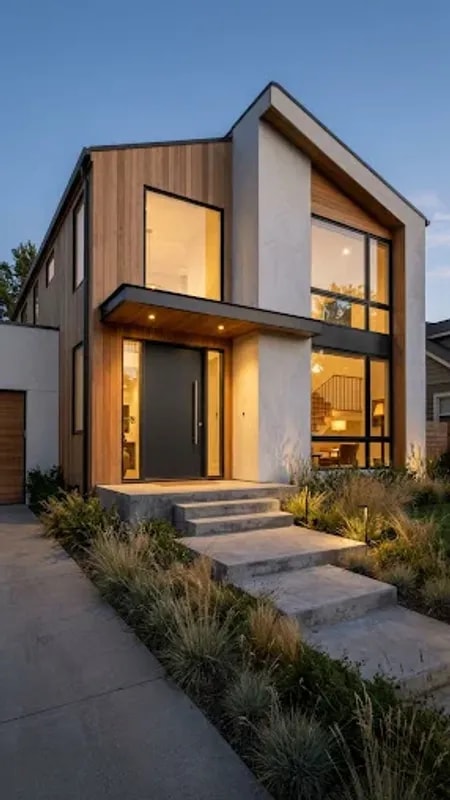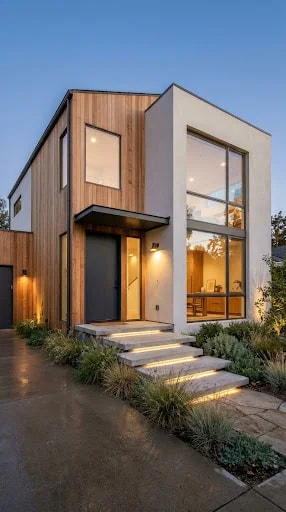
Most conversations about home front design start and end with the facade itself, but the houses that truly feel inviting are the ones that treat the approach as part of the architecture. This modern two-story home makes that clear the moment you pull in. The concrete driveway acts as a quiet runway, its pale surface reflecting whatever light is left in the sky, while the steps rise deliberately toward a charcoal front door. Nothing about the path feels accidental. Each element hands you off to the next, from the curb to the threshold, and the result is a front entry that feels less like a boundary and more like an invitation.
The vertical rhythm of the exterior does most of the heavy lifting. Warm cedar-toned wood siding climbs the facade in narrow planks, pulling the eye upward and making the two stacked volumes read as taller and more graceful than they probably are. Against that warmth, crisp white stucco provides the pause, a clean breath between the timber sections. Dark-framed windows sit flush and wide, their deep charcoal tone echoing the front door and tying the composition together. It is a simple palette, wood, white, and near-black, but the restraint is what makes the geometry legible instead of busy.
Lighting is where the design becomes generous. Recessed LED strips wash the concrete steps in a soft amber glow, tracing the route without shouting about it. Inside, warm light spills through the large windows, offering a glimpse of the life beyond the glass, and the contrast against a deepening blue evening sky is what gives the house its sense of calm. Notice how the illumination is layered rather than uniform: bright at the entry, softer along the walls, dim past the landscaping. That gradient is the difference between a house that looks lit and a house that looks lived in.
Landscaping plays a supporting role and knows it. Muted green plantings sit low and rounded, softening the hard edges of concrete and steel without competing with the architecture. No hedge is allowed to swallow a window; no shrub obscures the stair. The plants frame the approach and then step back.
If there is a lesson to borrow, it is this: design the walk, not just the wall. Choose a material palette you can repeat from driveway to door, give the vertical lines room to breathe, and light the path in gentle layers. A home front built this way does not simply look composed in photographs. It greets you, every single evening.