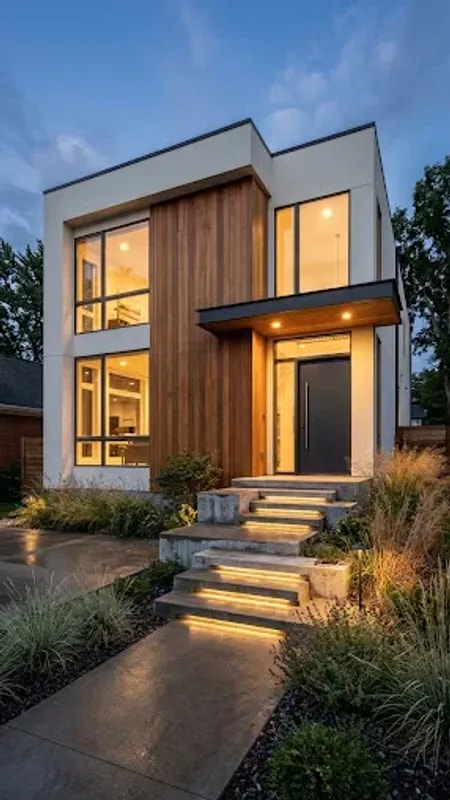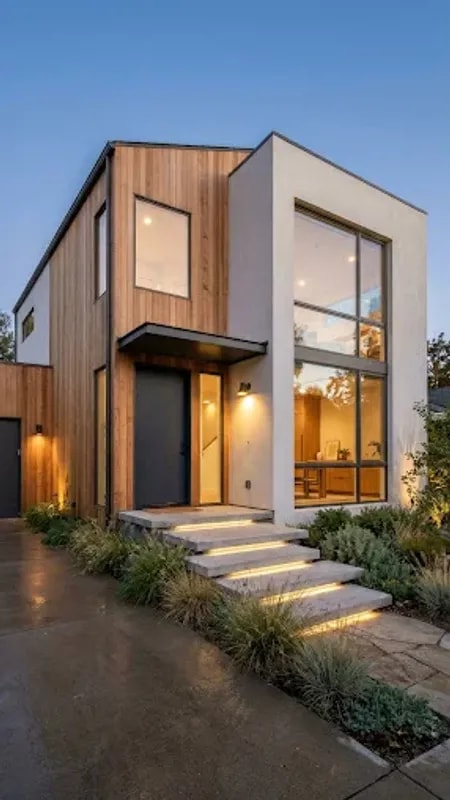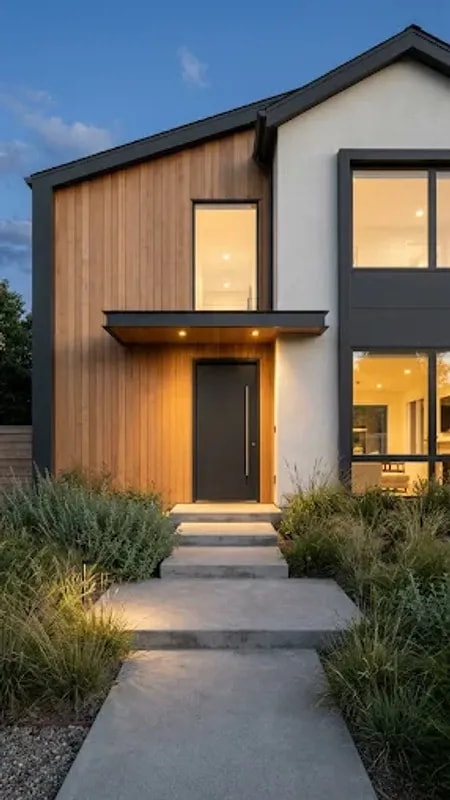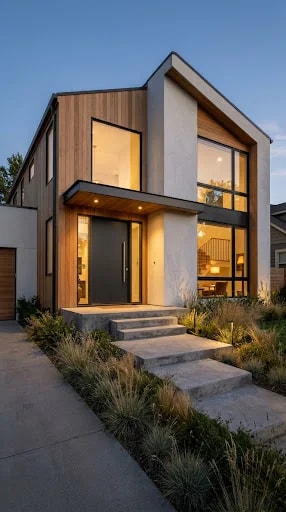
Dusk is the honest hour for a home's front elevation. Daylight flatters almost anything, but once the sky turns that deep, saturated blue, a facade either holds its composition or dissolves into a dark silhouette. This two-story contemporary home holds it beautifully, and the reason is a simple one: the design was planned as a nighttime object, not just a daytime one. Warm amber light spills from the interior through tall black-framed windows, recessed soffit lights graze the overhang, and the entrance reads as a lantern at the top of a wide concrete stair. The result is a house that seems to lean forward and invite you in.
The material story is what makes that glow legible. Vertical wood siding brings grain, shadow lines and a soft warmth that flat stucco can never match, while smooth white planes push back against it for contrast. Dark charcoal accents — window frames, the front door, the fascia — act as the outline that holds the whole composition together. Notice how few materials are actually in play: three tones and two textures, repeated at different scales. That restraint is the discipline behind most modern elevations that age well. Instead of adding another cladding or a decorative bracket, the designer let proportion and light do the work.
The approach is choreographed with equal care. A broad concrete stairway flanks low plantings of ornamental grasses, chosen because they move in the breeze and need almost no maintenance — a reminder that the front yard should support the architecture rather than compete with it. The path acts as a leading line, pulling the eye up and inward to the door, while the grasses soften the hard edges of masonry and concrete without hiding them. If you are reworking your own front approach, borrow the logic: one clear route, one repeated planting, and lighting that marks the way rather than flooding it.
Lighting deserves its own budget line. Layered exterior light — interior spill, recessed overhang downlights, and a discreet path wash — creates depth that a single porch fixture can't. Warm bulbs in the 2700K to 3000K range keep the effect cozy against a cool evening sky, and putting them on separate switches or a dimmer lets you shift the mood from arrival to late night. Aim fixtures downward and toward surfaces, never straight out at the street, and keep the total output modest; contrast, not brightness, is what reads as luxury at dusk.
The takeaway is refreshingly practical. Choose two or three materials and repeat them, frame glass in a dark tone so windows read as objects rather than holes, and treat your entry as the focal point it already is. Then drive past your own house at twilight before you commit to a final palette. The version of your front elevation that appears after sunset is the one guests, neighbors and future buyers will remember.