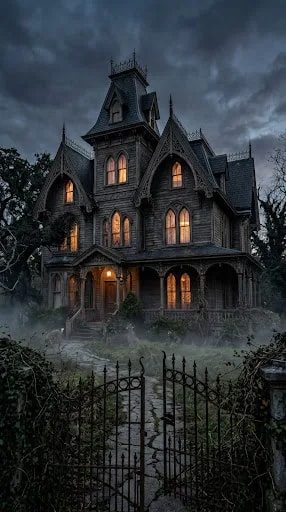
A common misconception paints Gothic architecture as purely forbidding, a monolithic wall of stone meant to repel. Yet the most evocative examples, like this shrouded mansion, master a more complex and compelling emotional language. They don't just intimidate; they entice. The visual key lies in the deliberate contrast between the environment and the dwelling itself. Here, the exterior world is rendered in cold, desaturated tones of charcoal grey and murky green, a landscape swallowed by mist and shadow. The house emerges from this gloom not as a blunt silhouette, but as a beacon of intricate, warm amber light.
This is not the harsh, clinical glare of modern security lighting, but the flickering, organic glow of firelight or aged lamps visible through pointed arch windows. It suggests life within the stone, a hearth in the heart of the vaults. This warmth becomes a narrative device, transforming the structure from a mere edifice into a character with an inner life. The light spills out, catching the details of ornate spires and the texture of the cracked pathway, inviting speculation about who, or what, might be inside.
The composition locks this invitation into a formal visual contract. The low vantage point, looking up through the rusted wrought-iron gate, forces a sense of awe and scales the house to mythic proportions. Yet the gate itself, while weathered and overgrown, is not fully closed. It frames the stone path, creating a literal and metaphorical corridor for the eye—and by extension, the imagination—to travel from our world into that amber-lit one. The path leads directly to the shadowy porch, the architectural equivalent of an open hand.
This technique speaks to the core of Gothic storytelling in design. It leverages mystery not as an end, but as a beginning. The foreboding atmosphere establishes stakes and a mood of thrilling unease, while the careful deployment of warm light provides the hook. It asks a question more powerful than any statement: Do you dare approach to discover the source of that glow? The resulting feeling is not simple fear, but a potent cocktail of curiosity and cinematic anticipation.
Ultimately, this image demonstrates that the most successful Gothic exteriors understand the psychology of welcome as well as they understand the grammar of dread. They are stage sets for a personal drama, where the viewer is cast as the protagonist standing at the threshold. The design doesn't push you away; it pulls you in, making the first step onto that cracked pathway feel like a choice you are compelled to make, one glowing window at a time.