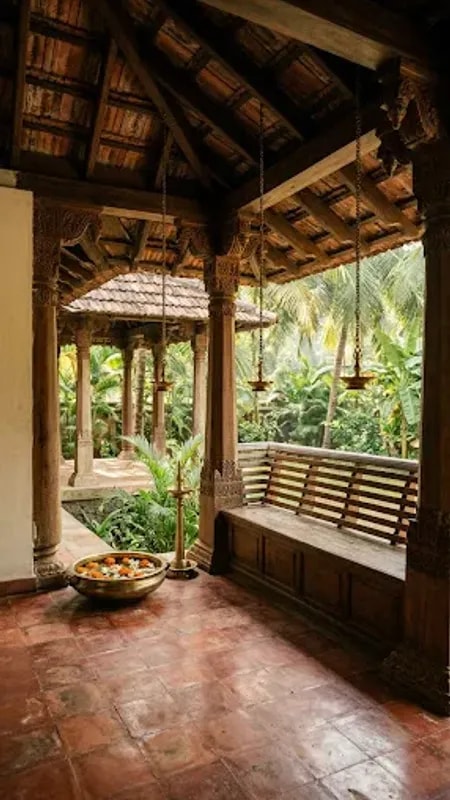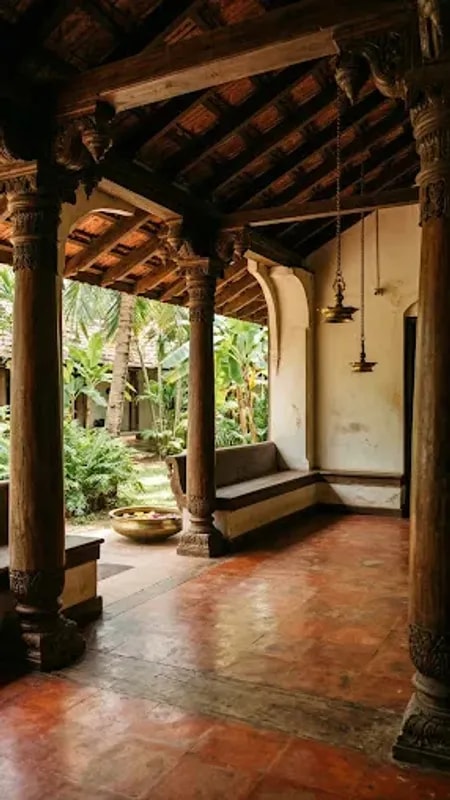
In a Kerala home, the most lived-in room often has no door. The verandah — the thinna or poomukham that wraps the front of the house — sits half inside and half out, shaded by a deep sloping roof and framed by carved wooden pillars that do the work of walls without blocking a single breeze. Step onto its polished red floor and you have already left the street behind. The garden is right there, close enough to touch, and yet the light has softened, the air has cooled, and the day seems to slow by a few degrees.
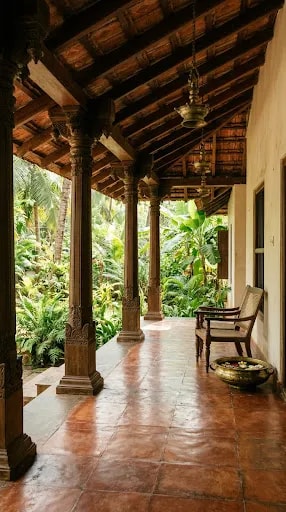
The structure itself is a lesson in climate before it is a lesson in style. Wide eaves throw a band of shade across the floor for most of the day, while the open sides let cross-ventilation pull hot air up and out through the roof. Terracotta tiles, laid in a lime mix and polished to a low sheen, stay cool underfoot even in April and grow more beautiful with every monsoon. Pillars are turned from solid teak or jackwood, their bases and capitals carved with lotus motifs, mango leaves and curling vines — detail placed where hands and eyes actually reach, not scattered everywhere.
What makes the space feel inhabited are the objects, and they are few. A row of brass oil lamps hangs from the beam, unlit in the afternoon but still catching the light. Two vintage chairs with woven cane seats face the garden, angled slightly toward each other, as if a conversation has just paused. A brass urn of water holds a handful of floating flowers — jasmine, maybe a hibiscus from the shrub by the gate. None of it is arranged for an audience. This is the everyday ritual of a household that treats beauty as part of hospitality.
Look at how the view is managed. The pillars act as a colonnade, compressing the scene into vertical strips of green, then releasing it: palm, banana leaf, a slice of lawn, more palm. Dappled sunlight filters through the planting and lands in patches on the red floor, so the boundary between inside and outside is never a hard line — it is a flicker. That framing is the real trick of Kerala interior design. It does not decorate the garden; it edits it.
You can borrow the idea without owning an old tharavad. Start with one shaded edge of your house: a deep overhang, a ceiling fan, a floor of terracotta or oxide red, and a carved pillar or two salvaged from a demolition yard. Add cane seating, a brass lamp that actually gets lit at dusk, and a pot of water with flowers. Keep the palette to earth, wood and green. The point was never ornament for its own sake — it was a place to sit at the edge of the house, let the evening in, and simply breathe.