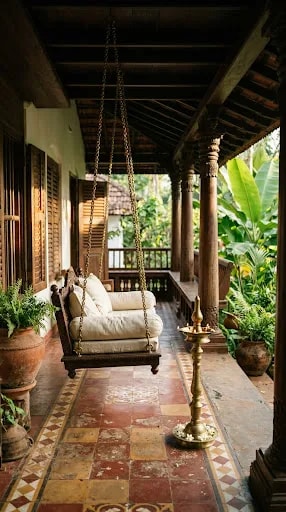
In a Kerala home, the veranda has always been the room that isn't quite a room. It sits between the house and the garden, shaded but open, and everything that matters drifts through it: monsoon air, filter-coffee conversations, the slow hour after lunch. The traditional oonjal hanging there on brass chains is the anchor of the space. Carved from dark hardwood and piled with plump white cushions, it does the work of a sofa, a daybed and a small stage all at once. Around it, polished pillars recede in a straight line, and the whole corridor seems to lean gently toward the light.
What makes this corner persuasive is the discipline of its palette. Nothing shouts. Earthy brown wood, terracotta floor tiles, cream upholstery, a single column of brass and a wall of tropical green beyond the colonnade — that is the entire scheme. The contrast comes from texture rather than colour: the grain of the pillars against the flat matte of the floor, the cool gleam of the chains against the soft cotton covers, the fine slats of the shutters throwing their own small shadows. Kerala style home decor works because it trusts a narrow set of materials and repeats them until they feel inevitable.
Bringing that feeling into a modern house is less about buying a swing than about borrowing the logic behind it. Start with the floor, since red-ochre oxide or terracotta is what gives the space its warmth underfoot. Add ventilation you can see: louvred shutters, a run of open pillars, a deep roof overhang that keeps the sun off while letting the breeze in. A tall brass oil lamp in a corner earns its place more than any shelf of ornaments, and one large potted plant near the opening will do more for the mood than a dozen small ones. Keep the seating low and generous, with washable covers in undyed cotton.
Proportion matters as much as objects. In the photograph, the pillars and ceiling beams pull the eye down the corridor in a single vanishing line, framing the swing without crowding it. That trick is repeatable: line up your columns or doorways, keep the ceiling beams exposed and painted the same tone as the walls, and let the far end of the view stay open to greenery. Deep focus, not clutter, is what reads as ancestral.
Then let the light finish the work. Warm daylight arriving from one open side, softening as it crosses the tiles, is the reason the space feels slow rather than staged. A veranda like this isn't decorated so much as kept — swept, aired, and left mostly alone, with a cushion smoothed and a lamp lit at dusk. The invitation is simple: sit down, put your feet up on the oonjal, and let the afternoon take its time.