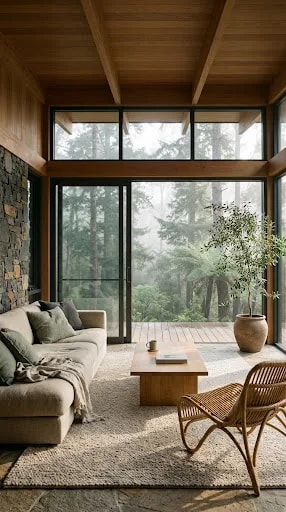
There is a particular kind of quiet that only happens when a room stops competing with what's outside it. In this living room, the black-framed glass doors do most of the talking: beyond them, a deck dissolves into fog and the soft silhouettes of firs. Inside, everything is turned slightly toward that opening — the long beige sectional, the low wooden table with a mug and a book left mid-sentence, even the woven rattan chair angled as if it has been pulled up to watch the weather. Nothing in the space asks for attention. The whole composition simply points at the trees.
That effect is not achieved with more stuff. It's achieved with texture, layered deliberately. A textured stone wall anchors one end of the room and gives the eye something tactile to rest on when the light goes flat and gray. Above, warm wood beams run across the ceiling and pull the forest's own palette indoors. Underfoot, cream upholstery softens the stone's weight, while the rattan chair introduces a loose, hand-made rhythm that keeps the room from feeling too resolved. In a retreat home, texture replaces ornament. You skip the gallery wall and the statement lighting and instead let grain, weave, and stone do the decorative work — surfaces that reward a second look on a rainy afternoon.
The furniture plan is almost aggressively simple, and that's the point. One deep sectional. One sculptural chair. One table low enough to feel like it belongs on a porch. A single potted tree in a terracotta vessel stands near the glass, tall enough to blur the boundary between the planted world and the built one. Notice the asymmetry: the seating isn't mirrored, the pillows aren't fluffed into formation, and the book is closed at an angle. A retreat living room should look like it's mid-use by someone who isn't performing relaxation for anyone.
Color does the rest. Warm wood, creamy neutrals, slate gray in the stone, and the living green of the tree and the mist-lit forest beyond — that's the entire palette, and it holds because it's borrowed. When your view is this good, the smartest move is restraint: let the green be the only saturated color in the room, and let the glass frame it like a canvas that changes hourly.
If you're chasing this feeling at home, start with one view. Clear the wall opposite it, choose a single texture to carry the room, and leave a little empty floor. The exhale comes from the space you don't fill.