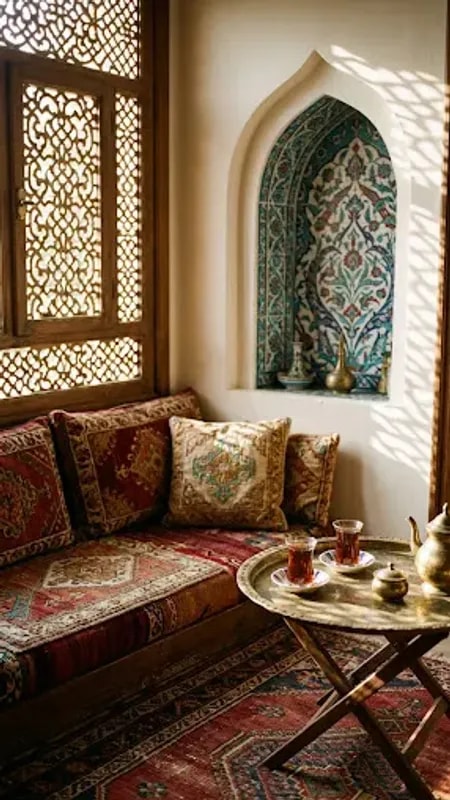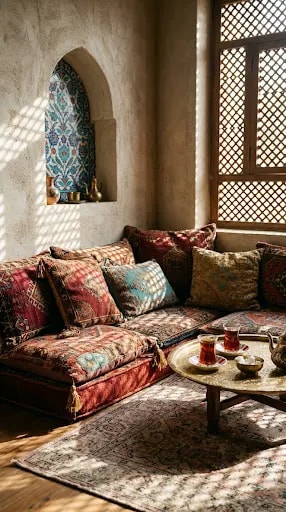
A Turkish home rarely puts the sofa at the center of the room and builds outward. More often it starts with a corner — a köşe — and lets everything else arrange itself around the person sitting there. In this sunlit nook, a low banquette runs along two plastered walls, its seat piled with kilim cushions in rust, red, teal and gold. A round brass tray on a short wooden stand sits within arm's reach, holding tea glasses, a small bowl and a teapot. The floor is covered by a faded rug, and light comes through a wooden lattice window, printing geometric shadows across the cushions and the wall.
The built-in seat is the piece worth copying. A platform roughly forty to forty-five centimeters high and sixty to seventy deep gives you a place to sit cross-legged or lean back against cushions without the bulk of a sofa. Build it in joinery and face it with lime plaster or tadelakt so the corner reads as carved from the wall rather than furnished. Sliding drawers under the seat swallow blankets and the tea service, which keeps the surface above clear. If you can only manage a freestanding bench, push it tight against two walls and treat the walls themselves as the backrest.
Textiles do most of the work. The rule that keeps a pile of patterned cushions from turning into noise is restraint in color and variety in scale. Here the palette stays within rust, teal, ochre and cream, but the motifs range from fine stripes to large medallions, and tasseled edges add texture without adding another pattern. Choose a flatweave rug that has softened with age, or wash a new one a few times, so it sits quietly under the brighter cushions.
The brass tray is the room's small engine. It is low, round and easy to move, and it holds whatever the visit needs: tulip glasses, a bowl of sugar, a pot of tea that will go cold before anyone leaves. A wooden base raises it just above knee height so you can reach without standing. Look for unpolished brass, which goes warm with handling, and a tray with a slight lip so glasses do not slide.
Finally, give the walls something to do. In this corner an arched niche is lined with blue and turquoise tile and scattered with small brass vessels, a quiet echo of the cushions opposite. A wooden lattice screen filters afternoon light into pattern, so the room changes through the day. None of these elements are expensive on their own. Together they make a corner that asks you to sit down and stay.