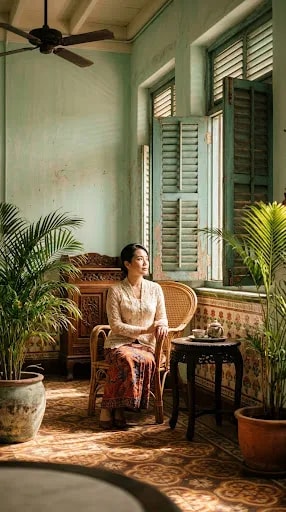
Every well-planned Nanyang interior has a chair that nobody moves. In this house it sits square to the louvered windows, low-backed and woven from rattan, with just enough give in the seat to make an hour pass without notice. The woman in the lacy kebaya and batik sarong occupies it the way the room intended: angled slightly outward, one hand resting, gaze lifted to the shutters rather than to anything on the wall. That is the whole design brief in a single frame. Before the tiles, before the timber, decide where a person will sit and what they will look at.
The framing does most of the work. Tall potted palms stand to either side of the windows, and a pair of large ceramic urns anchors the floor at their feet, so the view outward is narrowed into a soft green channel. Palms in a tropical interior are not decoration; they are movable architecture, cheap to reposition and forgiving of a room that has no money for built-ins. Set them slightly forward of the glazing and they will screen a neighbouring block or a service yard without ever looking like they were placed to hide something.
On the small side table, a tea set waits with the composure of an object that is used daily and put back correctly. This is the detail most modern recreations miss. Heritage rooms read as calm not because they are sparse but because everything in them has a job — the cup, the pot, the ceiling fan turning slow enough to be almost inaudible, the patterned floor tiles that have quietly taken on sixty years of scuff and shine. A room earns warmth through repetition, not acquisition.
The light is the last collaborator. Louvered shutters slice the afternoon into bands, laying a striped shadow across the floor and up the carved wooden screen behind her. You can borrow the effect without the original carpentry: face your seating toward the brightest window, keep the sill clear, and choose a slatted blind or a deep reveal rather than a flat pane. Fabric should be matte — cotton, linen, batik — so the glare softens instead of bouncing. Mint-green walls, as here, hold that diffused light beautifully and keep the earth tones of timber and terracotta from going heavy.
What the image really documents is a house designed for pause. The chair is not a staging prop left empty for photographs; it is occupied, and the room is arranged around the habit of occupying it. If you are reworking a shophouse terrace or simply a narrow city flat, take the cue. Leave one seat facing the garden, the courtyard or the street. Give it a table within reach, a plant at each shoulder, and light coming through something with slats. Then resist the urge to fill the space beside it.