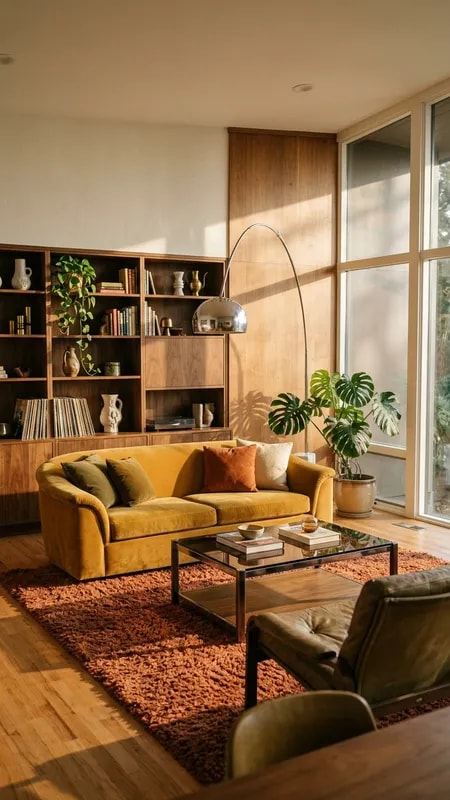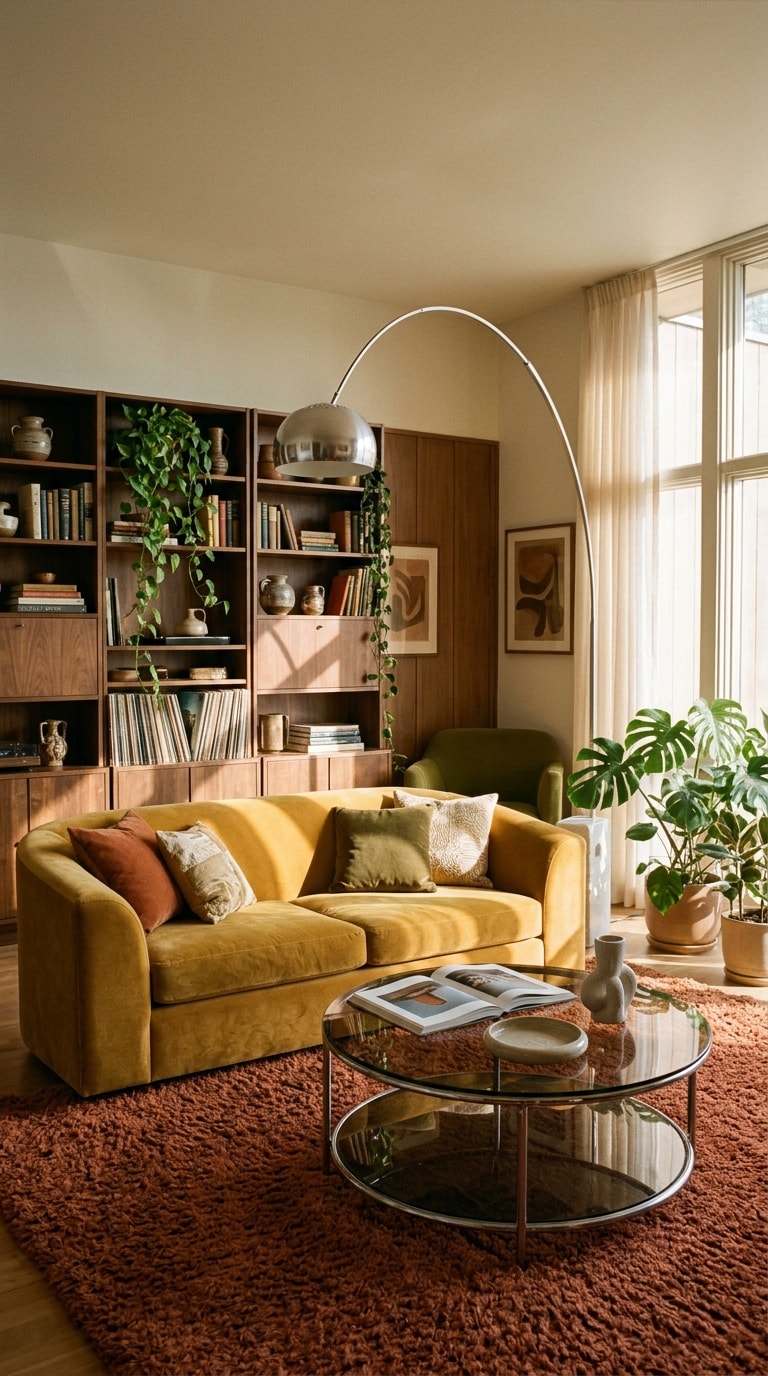
The quickest way to get 70s style wrong is to treat the decade as a costume. The room that works — the one you actually want to sink into — borrows the era's palette and its curves, then quietly refuses everything else. Here a curved mustard velvet sofa does all the talking. Everything around it stays calm: cream walls, tall windows softened by sheer curtains, walnut shelving that reads as architecture rather than decoration. One confident silhouette against a restrained envelope is exactly what separates modern-retro from a period piece.
Color discipline does the heavy lifting. Five tones carry the whole space — mustard on the sofa, rust in the shag rug, walnut on the shelves, olive on a single armchair, cream on walls and curtains. Notice where each one lands. The rust stays low, underfoot, warming the floor without shouting. The olive appears once, so the green chair reads as a deliberate accent instead of a theme. Shape works the same way: the sofa's curve, the lamp's long arc, the round glass table — all of them soften the shelving's rigid grid. Repeat a curve twice and it looks intentional; repeat it five times and it looks like a set.
Texture is the second trick, and it's what keeps a limited palette from going flat. Velvet catches the afternoon light, the shag rug absorbs it, the glass tabletop and the chrome dome lamp bounce it back. Matte wool, polished metal, soft pile, open glass — four finishes, no new colors required. The chrome arc is worth its footprint precisely because it ties the two halves of the room together, sweeping from the shelving side over the seating area so the eye travels instead of stopping.
Light and editing finish the job. Sheer curtains diffuse the sun so the velvet glows rather than glares, and warm late-afternoon light does more for a 70s palette than any lamp you could buy. Then edit hard. The walnut shelves are full but never packed — books, ceramics, trailing greenery, and visible gaps between them. Two open magazines and a small ceramic vase on the coffee table are the only signs of a person, and that's plenty. Lived-in is a styling decision, not an accident.
If you want the look, start with one hero piece in mustard, rust, or olive, keep the walls and windows cream, ground the seating on a rust rug, and add a single chrome arc lamp before you stop. Skip the macramé avalanche and the beige-everything compromise; the point of the decade was warmth and confidence, and both of those read as thoroughly modern when you leave room to breathe.