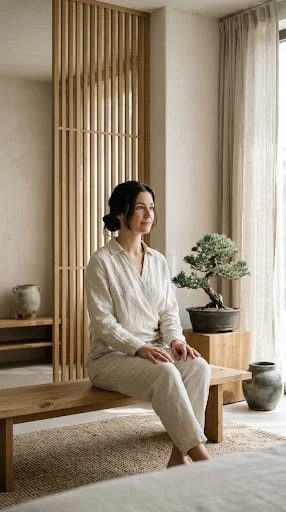
There is a particular hour in a Japandi home when nothing seems to be happening, and that is precisely the point. A woman settles onto a low wooden bench in loose cream linen, hands resting, shoulders down. Behind her a slatted divider combs the light into thin stripes. A bonsai sits on a plain block of wood, not centered, not styled into submission, just present. Sheer curtains on the right soften the daylight until it reads as a wash rather than a beam. Nothing in the frame asks for attention, which is why the whole scene holds it so easily.
The material story is where this style earns its calm. Warm light woods — ash, oak, pale pine — carry the structure, their grain left visible and their edges slightly rounded rather than sharp. Underfoot, a textured jute rug adds tooth and warmth without pattern noise. Ceramic vessels in chalky, unglazed finishes sit in clusters of two or three, their imperfect glazes doing the work that a printed cushion might do in a louder room. Linen appears again and again because it creases, breathes, and softens with every wash. Japandi takes the Japanese respect for restraint and wabi-sabi imperfection and joins it to Scandinavian hygge's insistence on comfort. The result is a room that feels both disciplined and kind.
Negative space is the quiet hero. Notice how the composition deliberately blurs a bed in the foreground so the eye lands on the woman, the divider, the bonsai. That shallow focus is a design lesson as much as a photographic one: decide what deserves to be sharp and let everything else go soft. In practice, this means resisting the urge to fill a bare wall. One object, given room to breathe, reads as intentional. Five objects read as clutter. A single bonsai on a wooden plinth will always out-communicate a shelf of decor.
If you want to borrow this mood at home, start with light and texture before furniture. Hang a sheer curtain where morning sun enters and let it diffuse the room's hardest hour. Choose one slatted or gridded screen to break up a large wall without blocking airflow. Keep the palette to warm wood, beige, cream, and a single muted green pulled from a plant. Then edit ruthlessly, leaving one bench, one rug, and a small group of ceramics where most rooms would carry three times as much.
Japandi style home design works because it treats the room as a place to recover rather than perform. Get the light, the wood, and the empty space right, and the slower morning happens on its own.